
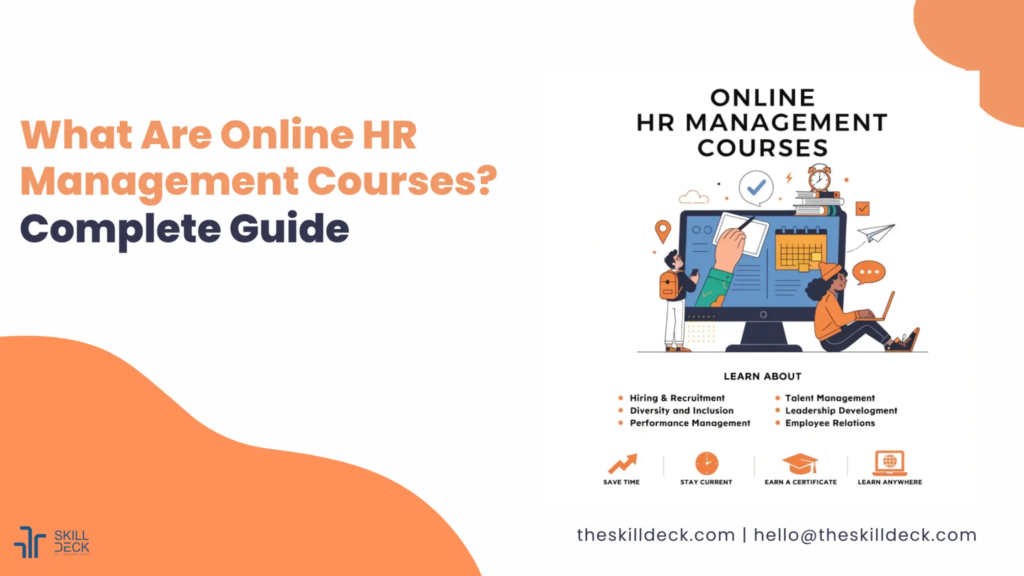
Online HR Management Online Courses Are Everywhere Right Now
I’ve spent years in HR, hiring, onboarding, and building people strategies, so when I talk about HR Management Courses Online, I’m not just reciting what’s out there. I’m telling you what actually works and what’s a waste of time.
HR has shifted from an administrative function to a strategic business driver. That shift, combined with rapid changes in AI, workforce models, and global hiring is why Online HR management courses are growing so fast.
The global e-learning market reached USD 342.4 billion in 2024 and is projected to hit USD 682.3 billion by 2033, driven largely by corporate training demand (source: global e-learning market report).
My honest take? These courses aren’t just for career changers. They’re for anyone managing people who wants to stop making expensive, avoidable mistakes.
What Are Online HR Management Courses?
Online HR management courses are structured programs that teach you how to manage talent, systems, and business decisions in a modern workplace.
The big shift: these courses are no longer just about HR basics. They now focus on strategy, data, and technology integration.
Most professionals today spend only ~24 minutes per week on formal learning, which is why Online HR Courses are designed as short, focused modules that fit into work schedules (source: corporate eLearning statistics and ROI data).
Why Online HR management courses Are Growing So Fast
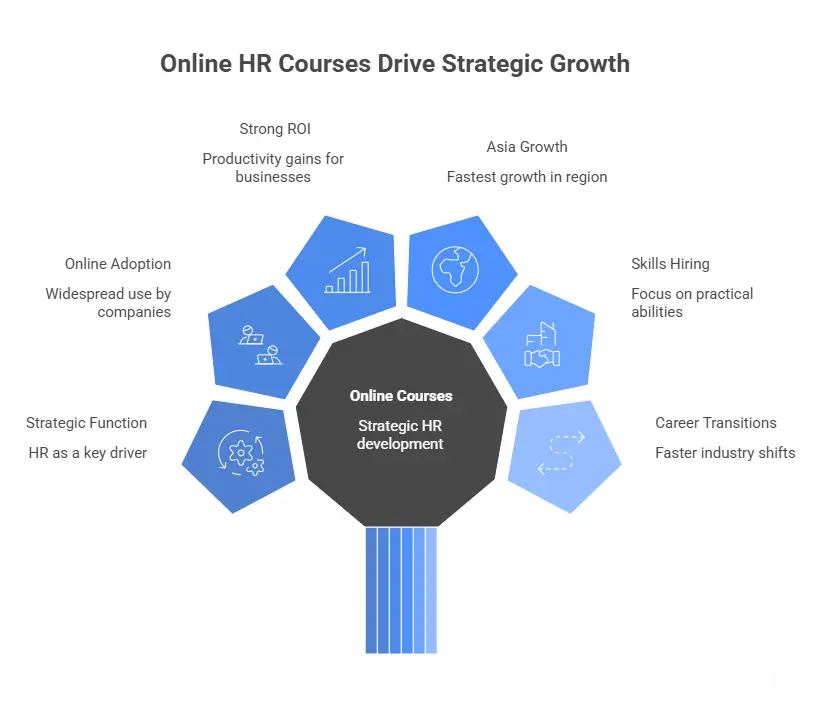
1. Companies Are Treating HR as a Strategic Function
Organizations now rely on HR for:
- Workforce planning
- Business strategy alignment
- Talent optimization
This is why corporate e-learning is growing faster than the overall market.
2. Massive Adoption of Online Learning
Around 98% of companies use online learning for employee development (source: eLearning adoption statistics).
3. Strong ROI for Businesses
Online learning delivers up to 30:1 ROI through productivity gains (source: corporate eLearning statistics and ROI data).
4. Asia (Including India) Is a Growth Engine
The fastest growth in HR learning is happening in Asia-Pacific, driven by digital adoption and large working populations.
5. Shift Toward Skills-Based Hiring
Companies are moving away from degree-based hiring and focusing more on practical skills. This increases demand for short, job-focused certifications that can prove capability quickly.
6. Faster Career Transitions Across Industries
Professionals from non-HR backgrounds are moving into HR roles using online courses. These programs reduce the time required to switch careers compared to traditional education paths.
Types of Online HR Management Courses
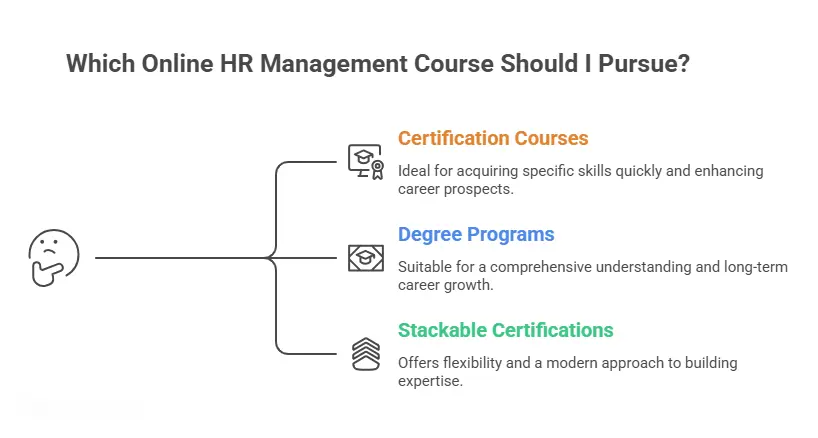
1. Certification Courses (Skill-Focused)
Short programs designed for immediate application.
These align with industry certifications like (see SHRM vs HRCI certification comparison):
- SHRM (competency-based)
- HRCI (technical knowledge)
- AIHR (skills + digital HR)
They typically take 3–6 months and are widely used for career progression.
2. Degree Programs (Long-Term Path)
- Duration: 3–5 years
- Focus: theory + leadership
Around 40% of HR managers hold advanced degrees, often linked to leadership roles (source: HR degree vs certification analysis).
3. Stackable Certifications (Modern Approach)
Professionals now combine multiple certifications in areas like:
- HR Analytics
- Compliance
- Talent Acquisition
This creates a customized skill profile aligned with market demand.
Certifications vs Degrees: What Should You Choose?
| Factor | Certifications | Degrees |
| Duration | Weeks to months | 3–5 years |
| Cost | Low to medium | High |
| Focus | Practical skills | Theoretical + strategic |
| Career Impact | Immediate | Long-term |
| Flexibility | High | Low |
HR Online Courses offer faster ROI. Degrees support long-term leadership growth.
What You Actually Learn in Good HR Management Online Courses
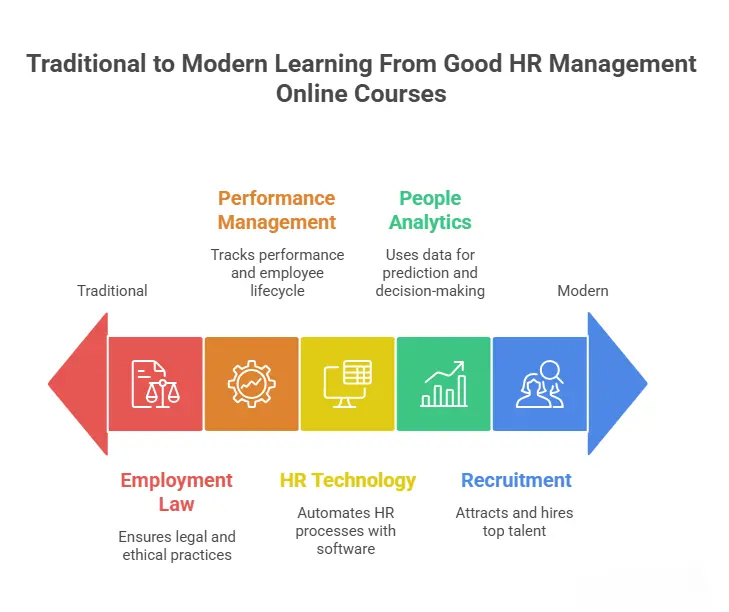
1. Recruitment & Talent Acquisition
- Boolean search
- AI-based sourcing
- Recruitment funnel optimization
2. People Analytics (Core Modern Skill)
Courses now focus on:
- Predicting employee turnover
- Workforce demand forecasting
- Data storytelling using dashboards
The shift is from reporting → prediction → decision-making.
3. Employment Law & Compliance
- Labor regulations
- Payroll compliance
- Risk management
4. Performance & Workforce Management
- OKRs and KPIs
- Continuous performance tracking
- Employee lifecycle management
5. HR Technology Stack
| Category | Purpose |
| HRIS | Employee data management |
| ATS | Recruitment automation |
| LMS | Training delivery |
| Payroll | Compensation & compliance |
These systems act as a single source of truth, reducing manual work and improving decision-making (see HR tech stack guide).
The Role of AI in Modern HR Management Online Courses
AI is now central to HR workflows.
Courses include:
- Prompt-based HR tasks (job descriptions, communication)
- AI-powered recruitment tools
- Bias and ethics in automation
HR roles requiring tech skills increased significantly after AI adoption.
Organizations investing in AI learning see higher training completion and productivity gains (source: emerging HR technology skills report).
Salary Impact: Do HR Certifications Really Pay Off?
- Entry-level certifications: 5–15% salary increase (source: HR certification salary impact report)
- Senior certifications: 15–25% increase
Example:
- $1,500 investment → ~$6,500 annual increase
- 82% of certified professionals get promoted within 5 years (source: HR certification salary impact report)
Certifications improve both salary and career mobility.
What Makes a Good Online HR Course (And What to Avoid)
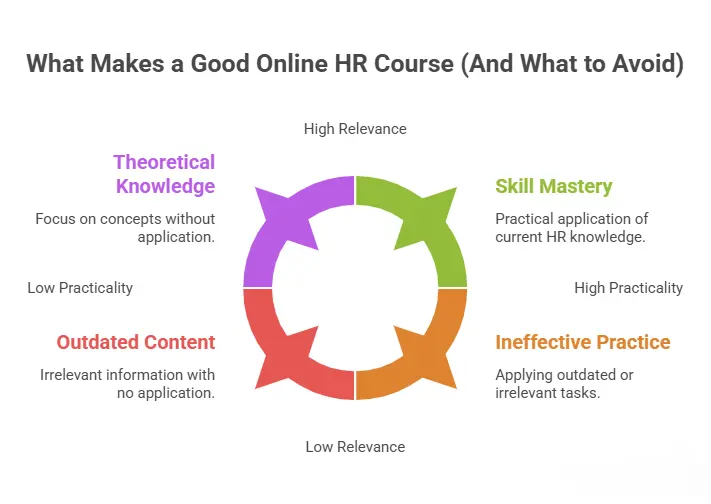
What to Look For
1, Real-World Case Studies
Look for programs that use actual business scenarios—hiring for niche roles, handling employee disputes, redesigning performance systems, or fixing attrition issues. These help you understand how decisions impact outcomes like productivity, cost, and retention.
2. Hands-On Assignments
Strong hr management online courses make you do the work—build recruitment pipelines, create HR MIS reports, draft policies, or analyze employee datasets. If you’re not producing outputs, you won’t build job-ready skills.
3. Tools Training (Excel, HR tech, analytics)
You should work with tools used in real companies—Excel for reporting, ATS for hiring workflows, and dashboards for analytics. Modern HR relies on systems, not spreadsheets alone.
4. Updated Curriculum (AI, analytics, compliance)
Courses should cover AI-assisted hiring, people analytics (predictive turnover, workforce planning), and current compliance practices. Content that ignores these areas is already behind market expectations.
5. Simulation-Based Learning For Decision-Making
The best programs include simulations where you make HR decisions (hiring, training, rewards) and see their impact on business metrics. This bridges the gap between theory and real-world execution.
6. Mentorship or Expert Feedback
Courses that provide access to mentors or industry experts help you correct mistakes, improve decision-making, and understand real workplace expectations faster.
7. Portfolio or Project Output
Look for courses where you finish with tangible work—reports, dashboards, hiring plans, or case solutions. These can be showcased during interviews and give you a clear edge over other candidates.
What to Avoid
1. Theory-only Content
If it’s mostly videos and slides with no application, you’ll struggle to apply concepts on the job. HR requires decision-making under real constraints.
2. No Practical Exposure
Courses without assignments, projects, or case work won’t prepare you for actual roles. You should be practicing tasks like sourcing, reporting, and policy design.
3. Outdated Syllabus
If AI in HR, analytics, or modern HR tech isn’t covered, the course won’t match current industry needs.
4. Certificate-only Focus
Programs that emphasize completion over capability don’t add much value. Employers look for skills you can demonstrate, not just certificates you hold.
Skill-Based Learning: The New HR Career Model
HR careers are shifting to a skills-first model.
Key trends:
- Certifications drive career growth and salary increases
- Professionals build stackable skill sets
- HR roles are becoming specialized
- Skills matter more than job titles
Modern HR professionals follow a T-shaped model:
- Deep expertise (HR core)
- Broad skills (data, AI, business strategy)
Learning Experience: Why SkillDeck HR management Online Courses Work Better
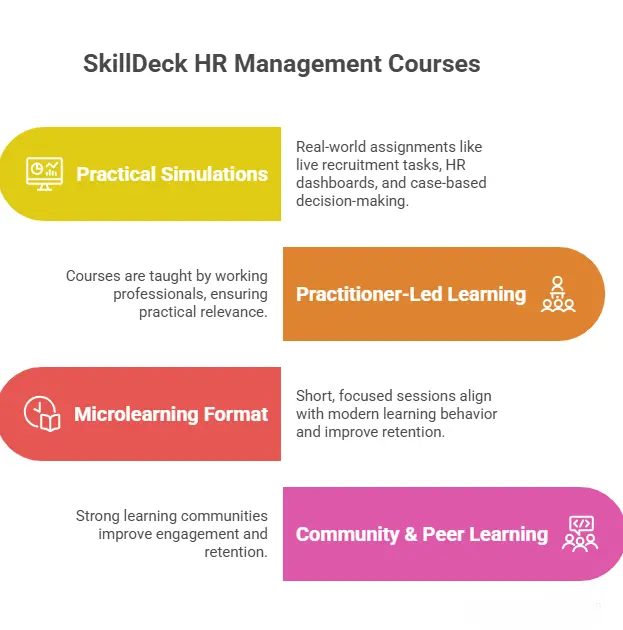
1. Practical Simulations
SkillDeck focuses on real-world assignments like:
- Live recruitment tasks
- HR dashboards
- Case-based decision-making
This reflects industry trends where simulations improve real-world readiness.
2. Practitioner-Led Learning
Courses are taught by working professionals, ensuring practical relevance.
3. Microlearning Format
Short, focused sessions align with modern learning behavior and improve retention.
4. Community & Peer Learning
Strong learning communities improve engagement and retention—employees are 76% more likely to stay when continuous learning is available (source: corporate eLearning statistics and ROI data).
Who Should Take Online HR Management Courses?
- Fresh graduates
- Working professionals switching to HR
- HR professionals upgrading skills
- Managers handling teams
Future of HR management online courses: What’s Coming Next
- AI + human collaboration in HR workflows
- “Build, Buy, Borrow, Bot” talent strategies
- Skills-based workforce planning
- Hybrid and flexible work models
HR is moving toward a data-driven, tech-enabled, human-centric model.
Final Thoughts: Should You Take an Online HR Course?
The right course can:
- Increase salary
- Improve decision-making
- Accelerate career growth
The wrong one?
Just a certificate with no real impact.
Choose based on skills, not certificates.
What You Should Do Next
Start with a practitioner-led program like SkillDeck’s HR certifications (see Talent Acquisition certification course).
- Choose a specialization (TA, HR Ops, Analytics)
- Focus on hands-on learning
- Apply skills immediately
- Stack certifications over time
That’s how you turn learning into real career growth.
Frequently Asked Questions (FAQs)
1. Are HR Management Online Courses Worth It For Career Growth?
Yes—data shows certified HR professionals see 5–15% salary increases and faster promotions. Courses that focus on practical skills like analytics, hiring, and compliance deliver the strongest results.
2. How Long Do HR Management Courses Online Typically Take?
Most certification-based programs take 3–6 months, while degree programs can take 3–5 years. Shorter courses are designed for working professionals with limited time.
3. Do Employers Recognize Online HR Certifications?
Yes. Certifications aligned with industry frameworks like SHRM, HRCI, and skill-based programs are widely recognized. Employers value demonstrated skills over just degrees.
4. What Skills Are Most Important In Modern HR Courses?
Key skills include:
- People analytics and data interpretation
- AI-assisted recruitment and HR workflows
- Compliance and employment law
- HR technology tools (ATS, HRIS, dashboards)
These reflect current industry demand and hiring trends.
5. Can I Switch to HR With Online Courses?
Yes. Many professionals transition into HR using certification programs. These courses reduce the time required compared to traditional degrees and focus on job-ready skills.
6. What Should I Check Before Enrolling In An HR Course?
Look for:
- Practical assignments and case studies
- Tool-based training (Excel, HR tech)
- Updated curriculum (AI, analytics)
- Mentorship or expert guidance
Avoid courses that only provide certificates without real skill-building.
7. Are HR Management online Courses Suitable For Managers?
Yes. Managers benefit from learning performance management, employee engagement, and data-driven decision-making—helping them lead teams more effectively.