
HR has shifted from administrative reporting to strategic decision-making. Organizations now generate vast amounts of workforce data through recruitment systems, HRIS platforms, learning systems, engagement surveys, and performance management tools. The challenge is turning this data into business value.
HR analytics helps organizations make workforce decisions using evidence rather than assumptions. Research shows that organizations with mature people analytics programs achieve stronger business outcomes, higher profitability, better retention, and improved workforce planning.
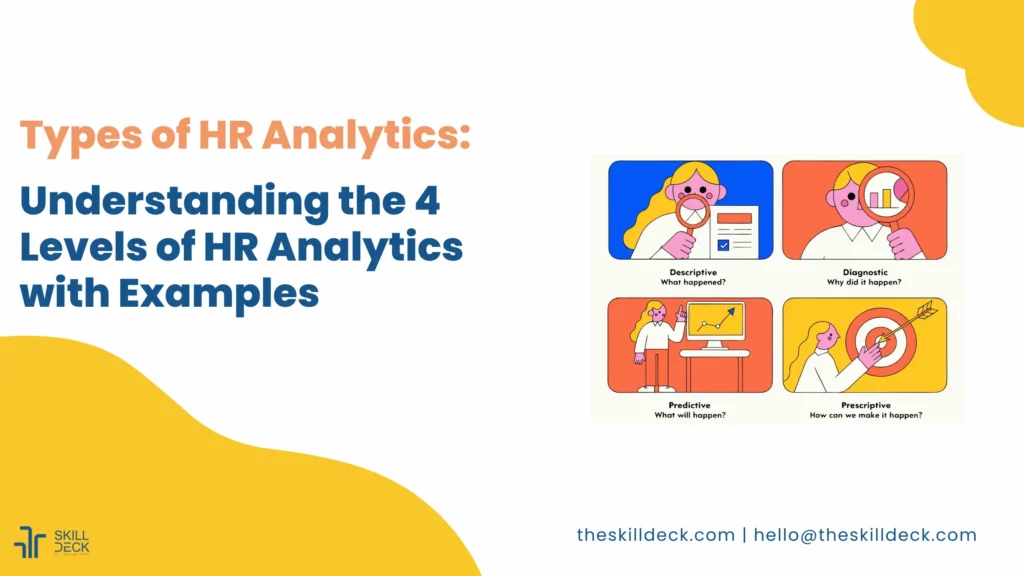
The evolution of HR analytics follows four stages:
- Descriptive Analytics
- Diagnostic Analytics
- Predictive Analytics
- Prescriptive Analytics
Understanding these types of HR analytics helps HR professionals move beyond reporting and contribute directly to business strategy. This guide explains the 4 levels of HR analytics, their practical applications, examples, tools, career opportunities, and future trends.
What is HR Analytics?
HR Analytics is the process of collecting, analyzing, and interpreting workforce data to improve talent and business decisions.
It helps organizations measure workforce performance, identify trends, solve people-related challenges, and support strategic planning.
Although often used interchangeably, there are differences:
| Area | Focus |
| HR Analytics | HR processes such as hiring, retention, compensation, and learning |
| People Analytics | Employee behavior and business outcomes |
| Workforce Analytics | Workforce productivity, planning, utilization, and operational efficiency |
Why HR Analytics Matters
Organizations invest heavily in people. HR analytics helps maximize the return on that investment.
Benefits include:
- Better hiring decisions
- Reduced employee turnover
- Improved productivity
- Stronger workforce planning
- Lower HR costs
- Better employee experiences
Research cited in the dossier shows organizations aligning people analytics with business goals are significantly more likely to achieve positive ROI from analytics initiatives.
Business Impact Example
Google’s Project Oxygen analyzed thousands of employee feedback records and performance reviews to identify what makes managers successful. The findings revealed that coaching, communication, and empathy were stronger predictors of leadership effectiveness than technical expertise.
HR Analytics vs Traditional HR Reporting
| Traditional Reporting | HR Analytics |
| Reports data | Generates insights |
| Reactive | Proactive |
| Describes events | Predicts outcomes |
| Historical focus | Future focus |
| Answers “What happened?” | Answers “Why?”, “What next?”, and “What should we do?” |
For example, reporting shows turnover increased from 12% to 18%. HR analytics identifies why employees are leaving, predicts future resignations, and recommends corrective actions.
Benefits of HR Analytics
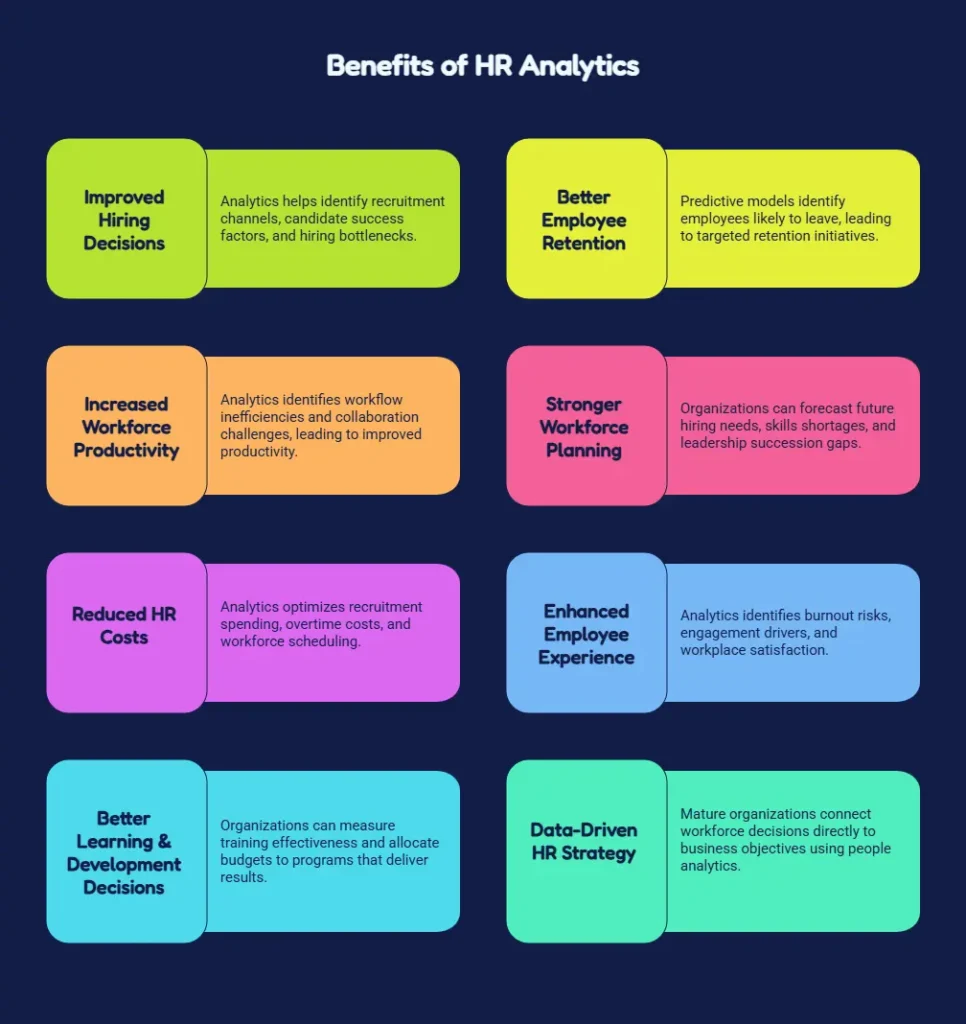
1. Improved Hiring Decisions
Analytics helps organizations identify:
- Best recruitment channels
- Quality of hire
- Hiring bottlenecks
- Candidate success factors
Unilever used analytics-driven hiring assessments that reduced candidate evaluation time by 75% while improving hiring outcomes.
2. Better Employee Retention
Predictive attrition models help identify employees likely to leave.
Credit Suisse used workforce analytics to identify flight risks and reportedly generated annual savings between $70 million and $100 million through retention initiatives.
3. Increased Workforce Productivity
Analytics identifies workflow inefficiencies, collaboration challenges, and workload imbalances.
Microsoft used workforce analytics to redesign meeting structures and improve productivity.
4. Stronger Workforce Planning
Organizations can forecast:
- Future hiring needs
- Skills shortages
- Retirement risks
- Leadership succession gaps
NASA applied skills analytics to identify future capability requirements and workforce gaps.
5. Reduced HR Costs
Analytics helps optimize:
- Recruitment spending
- Overtime costs
- Workforce scheduling
- Attrition expenses
One healthcare organization reduced overtime and bonus costs from approximately $112,000 per month to under $2,000 using workforce optimization analytics.
6. Enhanced Employee Experience
Analytics helps identify:
- Burnout risks
- Engagement drivers
- Workplace satisfaction
- Employee sentiment
IBM research cited in the dossier indicates personalized employee experiences can significantly improve retention outcomes.
7. Better Learning & Development Decisions
Organizations can measure whether training improves:
- Performance
- Productivity
- Customer outcomes
- Internal mobility
Learning analytics ensures training budgets are allocated to programs that deliver measurable results.
8. Data-Driven HR Strategy
The most mature organizations connect workforce decisions directly to business objectives using people analytics and workforce intelligence.
What Are the 4 Types of HR Analytics?
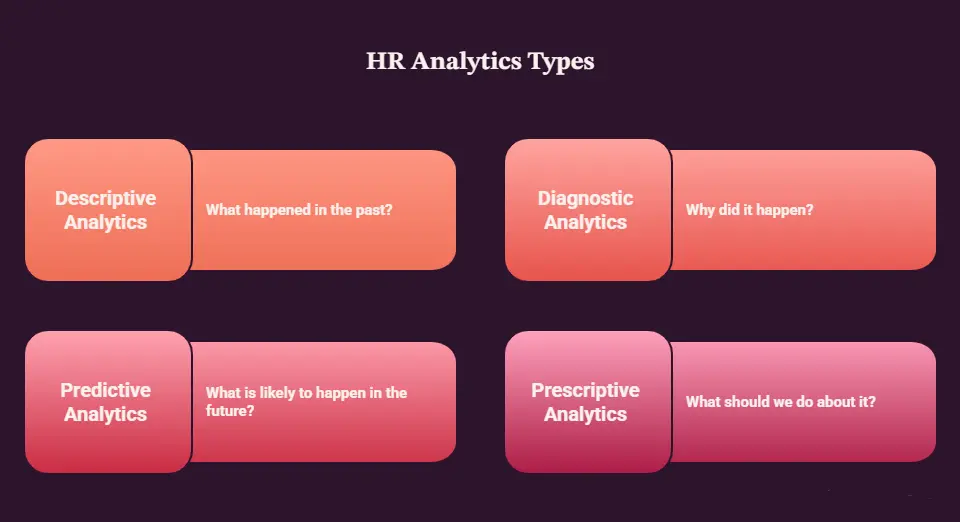
The four types of HR analytics are:
- Descriptive Analytics
- Diagnostic Analytics
- Predictive Analytics
- Prescriptive Analytics
Each level builds upon the previous one.
- Descriptive analytics explains what happened.
- Diagnostic analytics explains why it happened.
- Predictive analytics forecasts what is likely to happen.
- Prescriptive analytics recommends what should happen next.
The 4 Levels of HR Analytics Explained
| Type | Question Answered | Focus | Example |
| Descriptive | What happened? | Past | Turnover increased |
| Diagnostic | Why did it happen? | Past causes | Employees left because compensation was below market |
| Predictive | What will happen? | Future forecast | Predict employee resignations |
| Prescriptive | What should we do? | Recommended action | Improve compensation strategy |
Descriptive Analytics in HR
What is Descriptive Analytics?
HR professionals use Descriptive Analysis, also known as Decision Analytics or basic analytics to understand everything that has happened throughout the years. It leverages historical metrics and trends related to hiring rate, employee performance, office demographics, retention levels, and productivity to gain a perspective of what is happening in the present.
Descriptive analysis has minimal implications on the future but lays the groundwork for other types of HR analytics.
Descriptive HR analytics is necessary to understand the present workforce state. It offers clear insights that HR leaders can use for advanced analytics and to identify areas of more attention and investigation.
It answers: What happened?
How Descriptive Analytics Works
- Data collection
- KPI calculation
- Dashboard creation
- Trend analysis
- Reporting
Common HR Metrics Used
- Headcount
- Employee turnover
- Absenteeism
- Time-to-hire
- Cost-per-hire
- Employee satisfaction
- Training completion rates
Examples of Descriptive Analytics in HR
- Example 1: Employee Turnover Analysis
A dashboard shows turnover increased from 12% to 18%.
The organization understands what happened but not why.
- Example 2: PTO Usage Analysis
HR identifies departments with significantly higher leave utilization rates.
Advantages of Descriptive Analytics
- Easy to implement
- Creates workforce visibility
- Supports reporting requirements
- Establishes analytics foundations
Limitations of Descriptive Analytics
- Does not identify root causes
- Does not forecast future outcomes
- Primarily reactive
Diagnostic Analytics in HR
What is Diagnostic Analytics?
Amongst the HR Analytics types, diagnostic analytics is more precise in finding the reasons behind why something is happening. It is not just about uncovering issues in the workplace but also going a step further to identify the root cause of the problem, event, or results.
Diagnostic analytics is an extension of descriptive Analytics. HR professionals leverage historical metrics to study emerging patterns and trends related to certain events. They also check other unknown factors that have/will influence the event.
For instance, if there is rising employee dissatisfaction in the workplace, then diagnostic HR Analytics can help leaders identify why this is happening. Is it longer hours, tight deadlines, unsatisfactory pay, insufficient career growth etc.
Depending on the reasons, they can propose solutions to boost employee satisfaction.
It answers: Why did it happen?
How Diagnostic Analytics Works
Methods include:
- Root cause analysis
- Correlation analysis
- Regression analysis
- Data drilling
Diagnostic Analytics Techniques
- Data mining
- Statistical analysis
- Correlation analysis
- Probability analysis
Examples of Diagnostic Analytics in HR
- Example 1: Employee Engagement Issues
Analysis reveals low engagement is concentrated within teams reporting to specific managers.
- Example 2: Rising Absenteeism
Diagnostic analysis finds absenteeism is linked to shift schedules and workload patterns.
Advantages of Diagnostic Analytics
- Identifies underlying causes
- Improves decision quality
- Supports targeted interventions
Limitations of Diagnostic Analytics
- Requires high-quality data
- Correlation does not guarantee causation
- Focuses on historical outcomes
Predictive Analytics in HR
What is Predictive Analytics?
Unlike descriptive and diagnostic HR analytics types, which focus on the past and present, predictive HR analytics is for the future.
HR experts used this technique to answer questions like “what event will happen months or years from now?”, “What factors are responsible for the event?” and “What is the best course of action?”.
For example, HR teams can predict future employee turnover rates by analysing employee survey responses and performance reports. Predictive analysis data pinpoints high-performing employees and why they risk exiting the company in the future. The insights help HR teams implement suitable solutions to retain top talent.
Besides employee retention, predictive analysis also helps in –
- Recruiting the best talent in the market by forecasting the retirement rate
- Reducing employees’ skill gap with training by predicting upcoming technology trends
- Planning flexible and inclusive office spaces by predicting future remote or hybrid workforce trends.
It answers: What is likely to happen?
How Predictive Analytics Works
- Historical data analysis
- Pattern recognition
- Forecasting
- Machine learning models
Examples of Predictive Analytics in HR
- Example 1: Employee Attrition Prediction
The system identifies employees likely to resign based on engagement, compensation, tenure, and performance data.
- Example 2: Recruitment Forecasting
Organizations predict future hiring requirements using workforce planning models.
- Example 3: Future Skills Demand Prediction
Analytics forecasts future capability gaps based on business growth projections.
Predictive Analytics Use Cases
- Talent acquisition
- Retention
- Succession planning
- Workforce planning
Advantages of Predictive Analytics
- Enables proactive decisions
- Reduces attrition risk
- Improves workforce planning
- Supports succession planning
Limitations of Predictive Analytics
- Data quality dependency
- Potential model bias
- Requires specialized expertise
Prescriptive Analytics in HR
What is Prescriptive Analytics?
Prescriptive HR analytics goes one step beyond predictive analytics. While predictive analytics forecasts what is likely to happen in the future, prescriptive analytics recommends the best action to take based on those predictions. HR professionals use this approach to answer questions such as “What should we do to prevent employee turnover?”, “Which workforce strategy will deliver the best results?”, and “How can we improve hiring or productivity outcomes?”. For example, if predictive models indicate that high-performing employees are at risk of leaving, prescriptive analytics can suggest specific interventions such as salary adjustments, career development opportunities, internal mobility programs, or manager coaching. By combining data, AI, and decision-making models, prescriptive analytics helps HR teams choose the most effective course of action and improve workforce outcomes with greater confidence.
It answers: What should we do?
How Prescriptive Analytics Works
- AI-driven recommendations
- Optimization algorithms
- Scenario planning
- Decision modeling
Technologies Used
- Artificial Intelligence
- Machine Learning
- Pattern Recognition
- Big Data Analytics
Examples of Prescriptive Analytics in HR
- Example 1: Reducing Employee Attrition
The system recommends compensation adjustments, career development programs, or internal mobility opportunities.
- Example 2: Workforce Scheduling
Optimization models recommend staffing levels and shift allocations.
- Example 3: Learning & Development Recommendations
Employees receive personalized learning paths based on skills gaps and career goals.
Advantages of Prescriptive Analytics
- Recommends actions
- Improves decision quality
- Optimizes workforce investments
Limitations of Prescriptive Analytics
- High implementation complexity
- Significant technology requirements
- Ethical considerations
Types of HR Analytics with Examples
| HR Challenge | Analytics Type Used | Outcome |
| High Attrition | Predictive | Reduced turnover |
| Low Engagement | Diagnostic | Improved culture |
| Workforce Planning | Prescriptive | Better staffing decisions |
| Absenteeism | Diagnostic | Reduced absenteeism |
| Hiring Forecast | Predictive | Better recruitment planning |
This framework clearly demonstrates the practical value of the various types of HR analytics with examples.
HR Analytics Maturity Model
Organizations typically progress through four stages:
Level 1: Reporting
Basic dashboards and workforce reports.
Level 2: Diagnostics
Root cause analysis and workforce insights.
Level 3: Prediction
Forecasting attrition, hiring demand, and workforce needs.
Level 4: Prescription
AI-driven recommendations and workforce optimization.
As organizations mature, HR evolves from reporting metrics to influencing strategic business decisions.
Popular HR Analytics Tools
1. Microsoft Excel
Ideal for reporting, pivot tables, KPI tracking, and workforce analysis.
2. Power BI
Widely used for interactive HR dashboards and workforce reporting.
3.Tableau
Advanced visualization and executive reporting platform.
4. SAP SuccessFactors
Enterprise workforce planning, talent management, and analytics.
5. Workday
Integrated workforce planning and HR analytics platform.
6. Visier
Specialized people analytics and workforce intelligence solution.
7. Zoho People
Affordable HR platform for small and mid-sized businesses.
8. Google Looker Studio
Cloud-based reporting and dashboarding platform.
AI and the Future of HR Analytics
AI is transforming workforce decision-making.
1. AI-Powered Workforce Planning
AI forecasts workforce demand, skills shortages, and hiring requirements.
2. AI in Recruitment Analytics
Organizations use AI to improve candidate screening and hiring efficiency.
3. Generative AI for HR Insights
Generative AI can summarize surveys, analyze employee feedback, and generate workforce reports.
4. Predictive Workforce Intelligence
Organizations increasingly use AI to forecast:
- Attrition
- Hiring demand
- Skills shortages
- Leadership gaps
Decision Intelligence is becoming the next stage of workforce analytics maturity.
Career Opportunities in HR Analytics
Growing demand for workforce analytics has created numerous career opportunities.
1. HR Analyst
Analyzes workforce data and creates dashboards.
2. People Analyst
Studies employee behavior and business outcomes.
3. Workforce Planning Analyst
Forecasts workforce requirements and skills demand.
4. HR Business Partner
Uses workforce insights to support business decisions.
5. Talent Analytics Specialist
Focuses on recruitment and talent management analytics.
6. HR Data Consultant
Advises organizations on workforce analytics strategy.
Skills Required
- Excel
- Power BI
- Tableau
- Statistics
- SQL
- HR Metrics
- Data Visualization
- Workforce Planning
HR Analytics Interview Questions
1. What are the 4 types of HR analytics?
Descriptive, Diagnostic, Predictive, and Prescriptive Analytics.
2. What is the difference between predictive and prescriptive analytics?
Predictive analytics forecasts future outcomes. Prescriptive analytics recommends actions.
3. Explain descriptive analytics with an example.
A turnover dashboard showing turnover increased from 12% to 18%.
4. How does HR analytics improve retention?
By identifying turnover drivers and predicting employee flight risks.
5. Which tools are used in HR analytics?
Excel, Power BI, Tableau, SAP SuccessFactors, Workday, Visier, and Looker Studio.
6. What metrics are commonly tracked in HR analytics?
Turnover, absenteeism, time-to-hire, cost-per-hire, engagement, and productivity metrics.
Frequently Asked Questions
1. What Are The 4 Levels of HR analytics?
Descriptive, Diagnostic, Predictive, and Prescriptive Analytics.
2. What Are The Different Types Of HR Analytics?
The four primary types are descriptive, diagnostic, predictive, and prescriptive analytics.
3. What is Descriptive Analytics in HR?
Analysis of historical workforce data to understand what happened.
4. What is Predictive Analytics in HR?
Forecasting future workforce outcomes using historical data and statistical models.
5. What is Prescriptive Analytics in HR?
Recommending actions using AI, optimization techniques, and predictive insights.
6. Why is HR Analytics Important?
It improves hiring, retention, productivity, workforce planning, and business performance.
7. What Are Examples Of HR Analytics?
Attrition analysis, recruitment analytics, workforce planning, engagement analysis, and succession planning.
8. Which HR Analytics Tool Is Best?
Power BI, Tableau, Workday, Visier, and Excel are among the most widely used tools.
9. Is HR Analytics a Good Career?
Yes. Demand continues to grow as organizations invest in workforce intelligence and people analytics.
10. How Can I Learn HR Analytics?
Through practical projects, analytics tools training, HR metrics knowledge, and professional certification programs.
Conclusion
The four types of HR analytics—Descriptive, Diagnostic, Predictive, and Prescriptive—provide a framework for transforming workforce data into business value.
Organizations begin by understanding what happened, progress to identifying why it happened, forecast what is likely to happen, and ultimately determine the best actions to take.
As workforce analytics, AI, and people analytics continue to mature, organizations that use data-driven HR decision-making will be better positioned to attract talent, improve retention, optimize workforce planning, and strengthen business performance.
The demand for HR analytics professionals is growing rapidly, making this an excellent time for HR professionals to develop analytics capabilities.
Learn HR Analytics with SkillDeck
Build practical expertise in workforce analytics with SkillDeck’s HR Analytics Certification Course.
What You’ll Learn
- HR Metrics and KPIs
- Workforce Analytics
- People Analytics
- Recruitment Analytics
- Attrition Analytics
- Dashboard Development
- Excel for HR Analytics
- Power BI for HR Analytics
- Predictive Analytics Fundamentals
Program Highlights
- Industry-relevant curriculum
- Hands-on projects
- Real-world case studies
- HR analytics tools training
- Certification upon completion
- Career support
Explore SkillDeck’s HR Analytics Certification Course and build practical expertise in workforce analytics, reporting, dashboards, and data-driven HR decision-making.