
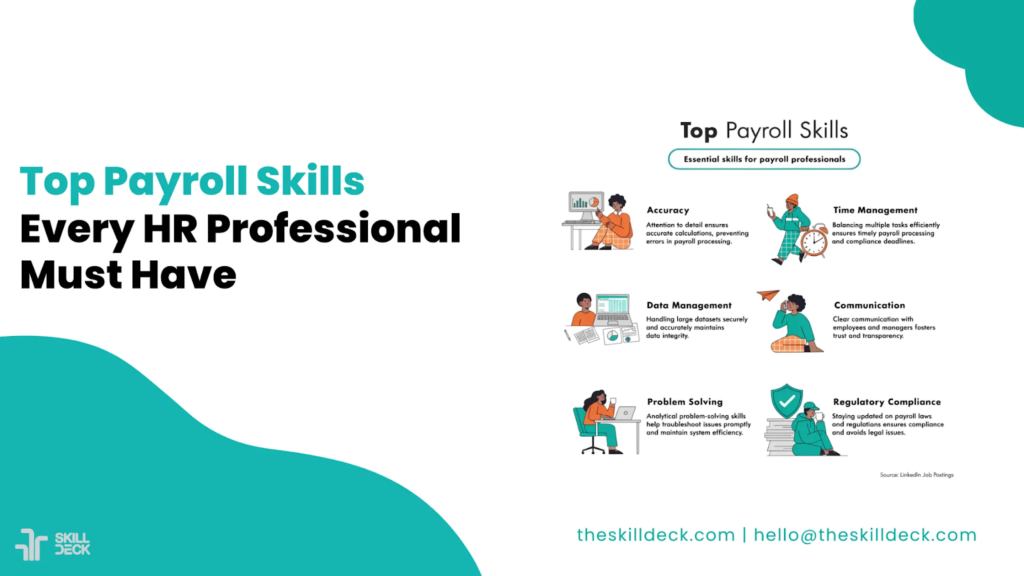
I’ve worked closely with payroll for years, and honestly, it’s one of those roles where precision matters more than anything. You can’t afford to be casual about it — salaries, compliance, deadlines… everything has to be spot on. From what I’ve seen, payroll is no longer just about processing salaries. It’s now deeply connected with compliance, finance, technology, and even employee experience.
If you’re planning to build a career in payroll — whether you’re a Payroll Specialist, HR Generalist, accountant, or even a business owner managing your own payroll — the skills you build today will decide how far you go.
In this guide, I’ll walk you through the top payroll skills every HR professional must have, based on real-world experience and current industry trends.
Why Payroll Skills Matter More Than Ever
Payroll has shifted from a back-office task to a high-impact business function. According to research on the future of global payroll trends, the global payroll market is expected to grow from $32.6 billion in 2025 to $51.4 billion by the end of the decade. That kind of growth tells you one thing, businesses are investing heavily in payroll systems, compliance, and talent.
At the same time, companies are moving toward real-time payroll processing and AI-driven systems, which means payroll professionals now need a mix of technical, analytical, and compliance skills.
Essential Payroll Skills You Must Know
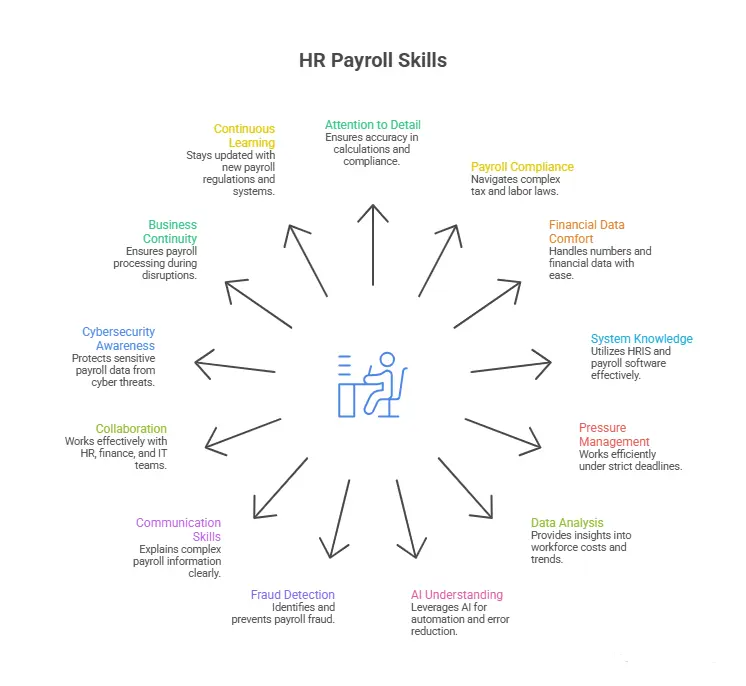
1. Attention to Detail (The Skill That Defines Payroll)
If there’s one skill that separates a good payroll professional from a great one, it’s attention to detail.
A small mistake in payroll — wrong tax deduction, incorrect overtime calculation, or missed compliance update — can lead to penalties, employee dissatisfaction, or even legal trouble.
From my experience, this is non-negotiable. You’re dealing with money, and people notice even the smallest errors.
What this looks like in practice:
- Verifying salary structures before processing
- Double-checking tax deductions and compliance rules
- Ensuring accurate attendance and overtime data
2. Strong Knowledge of Payroll Compliance (Especially in India)
Payroll is heavily tied to laws and regulations. If you don’t understand compliance, you’re at risk every single payroll cycle.
With remote work and global hiring, compliance has become even more complex. Businesses now deal with multi-jurisdiction tax rules, cross-border payroll, and strict reporting requirements as highlighted in this payroll compliance update.
Key areas you should know:
- Income tax, TDS, PF, ESI (for India)
- Labour laws and wage regulations
- Statutory filings and deadlines
- Cross-border tax rules for remote employees
Companies are facing heavy penalties for non-compliance globally, including fines running into billions, as reported in recent compliance penalty reports.
3. Comfort with Numbers and Financial Data
Let’s be real — payroll is numbers-heavy. If you’re not comfortable working with calculations, this field will feel overwhelming.
You don’t need to be a finance expert, but you should be confident handling:
- Salary structures
- Deductions and reimbursements
- Overtime calculations
- Payroll reconciliations
Payroll data also feeds into financial planning. Businesses use it to track labor costs and forecast future expenses.
4. Payroll Software & Systems Knowledge
Manual payroll is almost gone. Today, everything runs through systems.
Modern payroll is built on cloud platforms and integrated systems like HRIS, attendance tools, and accounting software. These systems communicate through APIs to ensure real-time data flow, as explained in this HRIS API integration guide.
Common tools you should know:
- HRIS platforms
- Payroll software (like ADP, Workday)
- Time & attendance systems
- Excel (still extremely important)
Understanding how systems connect is a big advantage.
5. Ability to Handle Pressure and Deadlines
Payroll runs on strict timelines. Salaries must be processed on time — no excuses.
I’ve seen situations where a small delay caused major employee frustration. Payroll deadlines don’t move, and you often work under pressure during month-end cycles.
What helps:
- Time management
- Process checklists
- Staying calm during peak cycles
6. Data Analysis and Reporting Skills
Payroll is not just about processing — it’s about insights.
Companies now expect payroll professionals to analyze workforce costs, overtime trends, and compensation patterns. Payroll data plays a key role in financial decisions.
Metrics like Total Cost of Workforce (TCOW) and Human Capital ROI are now part of payroll analytics, as discussed in this HR ROI analysis.
Example:
| Metric | What It Shows | Why It Matters |
| Total Cost of Workforce | Total employee cost including benefits | Helps control expenses |
| Overtime Trends | Extra hours worked | Identifies inefficiencies |
| Payroll Accuracy Rate | Error percentage | Improves compliance |
7. Understanding of AI and Automation in Payroll
AI is already changing payroll.
Systems can now detect anomalies, automate calculations, and reduce errors. In one case study, AI reduced payroll errors by 42% and processing time by 33%, as shown in this AI in payroll case study.
That said, human oversight is still required. You need to understand how these systems work and how to validate their outputs.
8. Payroll Auditing and Fraud Detection Skills
Payroll fraud is real — ghost employees, duplicate payments, and unauthorized changes.
Modern payroll requires continuous auditing instead of just month-end checks. Systems now flag anomalies like duplicate bank details or unusual salary patterns, as outlined in this payroll audit checklist
Key audit checks:
- Employee record verification
- Salary vs attendance validation
- Tax compliance checks
9. Communication Skills (Underrated but Critical)
This is something many people ignore.
Employees come to payroll with sensitive questions — salary issues, deductions, tax confusion. You need to explain things clearly without confusing them.
During payroll errors or delays, communication becomes even more important. Transparency helps maintain trust.
10. Cross-Functional Collaboration
Payroll doesn’t work in isolation. You constantly interact with:
- HR teams
- Finance departments
- Legal teams
- IT teams
Poor coordination between these teams can lead to errors, compliance issues, and financial mismatches, as explained in this global payroll systems guide.
11. Cybersecurity Awareness in Payroll
Payroll systems store sensitive data, bank details, salaries, personal information.
These systems are prime targets for cyberattacks, including phishing and fraud attempts. Advanced attacks now even use AI-generated messages to trick employees, as detailed in this cybersecurity report.
What you should know:
- Data protection basics
- Secure access practices
- Verification before payment changes
12. Business Continuity and Risk Management
Payroll must run even during disruptions — system failures, cyberattacks, or emergencies.
That’s why companies build payroll continuity plans to ensure salaries are processed even in crisis situations, as described in this payroll continuity planning guide.
13. Continuous Learning and Certifications
Payroll is always changing — new tax rules, new systems, new compliance requirements.
Certifications help you stay updated and build credibility.
Popular certifications:
| Certification | Focus Area | Best For |
| FPC | Basic payroll knowledge | Beginners |
| CPP | Advanced payroll & compliance | Experienced professionals |
| GPMI | Global payroll | International roles |
Key Payroll Skills Summary
| Skill | Why It Matters |
| Attention to Detail | Prevents costly errors |
| Compliance Knowledge | Avoids legal penalties |
| Numerical Skills | Ensures accurate calculations |
| Software Knowledge | Improves efficiency |
| Data Analysis | Supports business decisions |
| Communication | Builds employee trust |
| Auditing Skills | Prevents fraud |
Conclusion
Payroll might not be the most visible part of HR, but it’s one of the most important.
From what I’ve seen, the professionals who succeed in payroll are the ones who take accuracy seriously, stay updated with compliance, and adapt to new technology.
If you’re planning to build a career in this space, start with the fundamentals — accuracy, compliance, and systems and then build on analytics and automation.
If you want to fast-track your career, consider enrolling in a structured Human Resources Payroll Course that gives you hands-on exposure to real payroll scenarios.
The demand is growing. The opportunities are there. The question is are you building the right skills?
FAQs: Top Payroll Skills Every HR Professional Must Have
1. What Skills Are Required For Payroll Jobs In HR?
To succeed in payroll, you need a mix of technical and soft skills. The most important ones include attention to detail, knowledge of payroll compliance, numerical ability, payroll software proficiency, and communication skills. As payroll evolves, skills like data analysis, AI understanding, and cybersecurity awareness are becoming just as important.
2. Why Is Payroll Compliance Knowledge Important for HR Professionals?
Payroll compliance ensures that salaries, taxes, and statutory deductions are processed according to legal requirements. With increasing regulations and cross-border hiring, non-compliance can lead to heavy penalties and legal issues. This makes compliance knowledge a core skill for any payroll professional.
3. How is AI Changing Payroll Roles?
AI is automating many payroll processes such as calculations, anomaly detection, and reporting. It helps reduce errors and improves efficiency. At the same time, HR professionals need to understand how to monitor these systems, interpret outputs, and ensure accuracy, since human oversight is still required.
4. What Payroll Software Skills Should Hr Professionals Learn?
HR professionals should be comfortable using payroll systems like HRIS platforms, attendance tools, and accounting software. Understanding how these systems integrate using APIs and real-time data syncing is a major advantage in modern payroll roles.
5. What Are The Biggest Payroll Mistakes To Avoid?
Common payroll mistakes include incorrect tax calculations, misclassification of employees, missing compliance deadlines, and relying completely on automation without verification. Errors in payroll can lead to penalties and employee dissatisfaction, so accuracy is critical.
6. What Is Payroll Auditing and Why Is It Important?
Payroll auditing involves checking payroll data for errors, fraud, and compliance issues. It helps detect problems like ghost employees, duplicate payments, or incorrect deductions. Continuous auditing ensures financial accuracy and protects the organization from risks.
7. Is Payroll A Good Career Option In 2026 And Beyond?
Yes, payroll is becoming a high-demand career due to increasing compliance complexity, global hiring, and technology integration. As businesses invest more in payroll systems and analytics, skilled payroll professionals are needed across industries.