
Payroll looks simple from the outside. Salary credits arrive on time, payslips get emailed, and statutory deductions appear neatly calculated. The reality behind payroll work in India feels very different once you step into it. Compliance timelines, employee queries, audits, vendor coordination, and system accuracy create daily pressure.
For anyone planning a career in payroll, the course you choose matters. Yet for most learners, the bigger question sits beyond course content. The question revolves around placement support.
Payroll courses across India mention placement support, placement assistance, or placement guidance. Many learners sign up believing this means a job will follow automatically. The experience on the ground often tells a different story. This guide explains how placement support actually works in payroll courses, why it matters, and what to check before enrolling.
Why Placement Support Matters for Payroll Learners
Payroll roles demand more than textbook knowledge. Employers expect familiarity with live processes, compliance timelines, and system handling. A payroll course without career guidance leaves many learners stuck between certification and employment.
Industry discussions around payroll training show that structured placement support helps learners bridge this gap by linking skills with hiring expectations rather than only explaining concepts.
For freshers and career switchers, placement support creates exposure to:
- Real payroll job requirements
- Interview formats used by payroll vendors
- Resume screening patterns followed by recruiters
- Entry-level salary expectations across Indian cities
What “Placement Support” Means in Payroll Courses
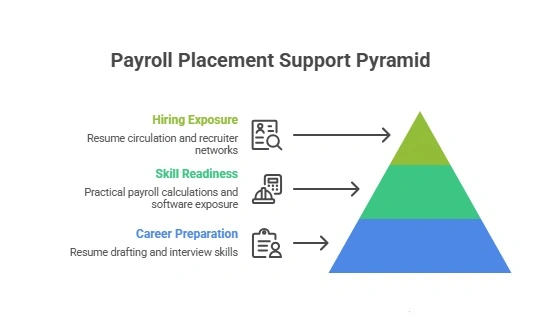
Placement support does not mean a job guarantee. It refers to structured career assistance designed to help learners move from course completion to interview readiness and early employment. In payroll training, this support focuses on preparation, exposure, and guided access to hiring processes rather than automatic placement.
Common Elements Included in Legitimate Placement Support
Career preparation
- Resume drafting aligned with payroll roles, focusing on statutory exposure, payroll cycles handled, and tools used, rather than generic HR descriptions
- Interview preparation centred on real payroll interview patterns, including compliance logic, salary structure questions, and scenario-based problem solving
- Mock interviews designed around actual payroll hiring rounds, often led by trainers or placement teams familiar with vendor and corporate expectations
Skill readiness
- Practical assignments built around payroll calculations such as gross-to-net salary computation, arrears handling, and deduction accuracy
- Case exercises covering PF, ESI, TDS, gratuity, and professional tax to help learners explain statutory logic clearly during interviews
- Exposure to payroll software workflows so learners understand data entry flow, validation checks, and month-end processing steps
Hiring exposure
- Resume circulation to payroll vendors, shared services teams, and HR operations roles where entry-level payroll hiring is common
- Access to recruiter networks and alumni referrals that introduce learners to opportunities not always posted on public job portals
- Regular updates on payroll openings across industries, along with guidance on which roles suit fresher or early-career profiles
Institutes that clearly define these elements usually deliver more dependable outcomes than those using generic placement language.
A Fresher’s View: What Placement Support Felt Like in Practice
As a fresher exploring payroll roles, I learned that placement support is more than just getting job alerts. The course helped me understand real payroll processes, Indian statutory compliances like PF and ESI, and how payroll interviews actually work. Regular assignments, practical exercises, and mock interviews made me more confident, and candidates who stayed consistent were clearly moved ahead for interviews with payroll vendors and third-party payroll companies. The placement support felt meaningful because it focused on making us job-ready, not just sharing openings.
Payroll Roles Usually Offered Through Placement Support
Payroll courses with hiring connections usually link learners to roles aligned with entry-level readiness.
Entry-Level Payroll Roles
- Payroll Executive
- Junior Payroll Officer
- Payroll Assistant
- Payroll Administrator
These roles focus on processing payroll cycles, maintaining records, handling employee queries, and supporting compliance activities.
Mid-Level Payroll Roles
- Payroll Specialist
- Payroll Analyst
- Senior Payroll Officer
These roles typically appear after experience builds and involve audits, reconciliations, and system coordination.
Key Things to Check Before Joining a Payroll Course with Placement Support
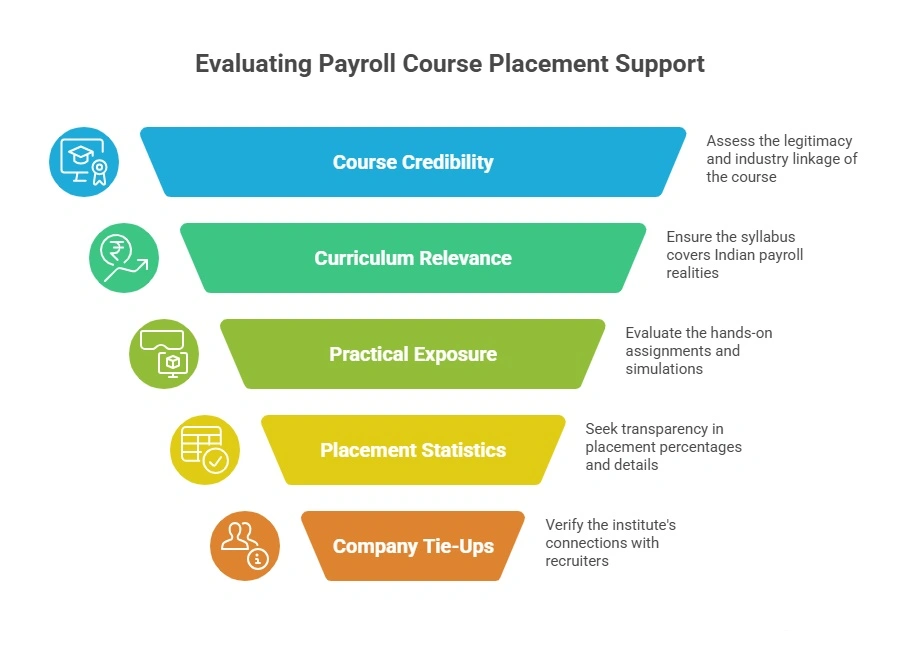
Choosing a payroll course based only on the phrase “placement support” often leads to confusion later. This section breaks down the exact areas you should review so you understand what kind of career assistance you are likely to receive and how reliable it may be.
Course Credibility and Recognition
A legitimate payroll training provider generally has:
- A detailed website with clear course information, learning outcomes, trainer profiles, and contact details, rather than just marketing pages
- Active LinkedIn presence where trainers, placement staff, and alumni interactions can be seen publicly
- Faculty listed with verifiable experience in payroll operations, compliance handling, or payroll systems, not just academic credentials
When these elements are missing, it becomes difficult to confirm whether the course has real industry linkage or only promotional claims.
Curriculum Relevance to Indian Payroll
The syllabus must reflect Indian payroll realities. Check for detailed coverage of:
- Provident Fund calculations, including wage ceilings, contribution limits, and monthly filing timelines
- ESI rules covering eligibility, contribution structure, and employee handling during audits
- TDS processing with salary components, exemptions, and Form 16 basics
- Gratuity computation logic and eligibility conditions
- Professional tax rules based on state-level slabs
Courses that treat statutory topics lightly often leave learners struggling to answer basic compliance questions during interviews.
Practical Exposure and Assignments
Placement-focused payroll courses rely heavily on assignments such as:
- Monthly payroll simulations that mirror real salary processing cycles
- Payslip generation tasks that require accuracy in deductions and net pay calculation
- Compliance worksheet exercises designed to test understanding of statutory logic
- Error-handling scenarios where learners identify and correct payroll mistakes
These activities help learners explain their work clearly in interviews instead of relying on theory alone.
Placement Statistics Transparency
When institutes mention placement percentages, ask for clarity on:
- Number of students placed per batch and how many actively participated in placement activities
- Types of companies involved, such as payroll vendors, HR consulting firms, or in-house payroll teams
- Salary ranges offered so expectations remain realistic for entry-level roles
Institutes that can explain these details calmly and clearly usually maintain structured placement processes.
Company Tie-Ups and Recruiter Access
Strong placement programs maintain contact with payroll vendors, HR consultancies, and shared services teams. Evidence may include:
- Hiring drive announcements conducted for recent batches
- Alumni placement examples that can be verified through LinkedIn profiles
- Named recruiter partners rather than generic references to “multiple companies”
These indicators suggest the placement support goes beyond forwarding resumes and involves active recruiter engagement.
Red Flags to Watch Out For
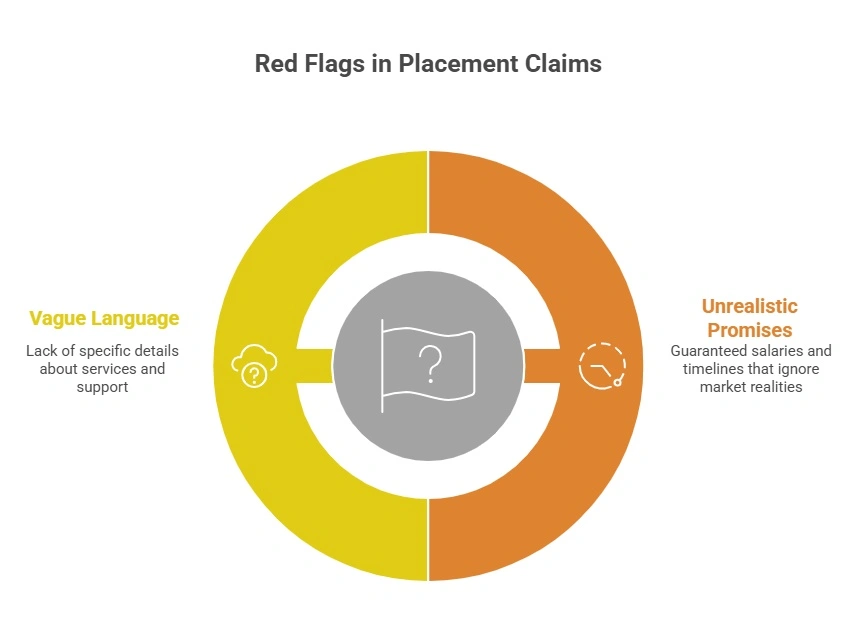
Certain signals indicate unreliable placement claims. Spotting these early can save time, money, and frustration, especially for freshers who rely heavily on guidance.
Unrealistic Promises
- Guaranteed salaries that are presented as fixed outcomes, without any reference to interview performance, skill level, or location
- Fixed placement timelines such as promises of a job within 15 or 30 days, ignoring market conditions and hiring cycles
- Mandatory upfront payments linked directly to job offers, registration for interviews, or so-called joining formalities
In real payroll hiring, outcomes depend on preparation, interview performance, and employer requirements. Absolute promises rarely reflect how recruitment works.
Vague Placement Language
- “100% assistance” without a written breakdown of services like resume support, mock interviews, or recruiter referrals
- No placement team details, such as the absence of named placement officers or career coordinators
- Refusal to share alumni references or examples of recent placements that can be independently verified
When placement support is genuine, institutes are usually open about their process, people involved, and past outcomes. Lack of clarity often points to minimal or symbolic support.
How Placement Support Actually Works in Payroll Careers
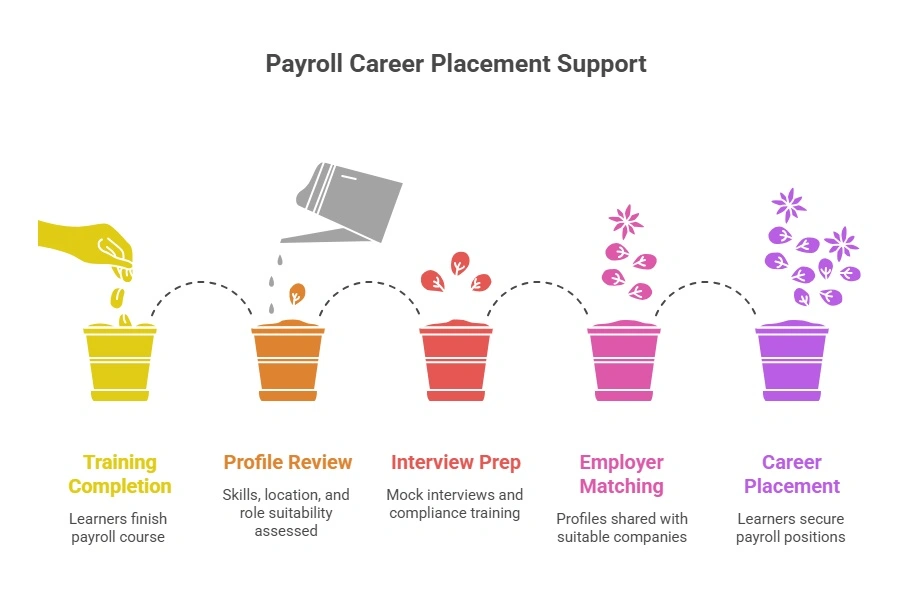
Understanding how placement support functions in real payroll careers helps set clear expectations. Instead of a one-time referral, placement support usually follows a step-by-step process that runs parallel to training and continues after course completion.
The Placement Team Structure
Most institutes operate with:
- A placement officer who acts as the main point of contact between learners and hiring companies, coordinating interviews, resume sharing, and follow-ups
- Career coordinators who guide learners on resume structure, role selection, and readiness based on individual progress
- Faculty mentors who connect classroom learning with interview expectations, often helping learners explain practical payroll concepts clearly
This combined structure ensures learners are not left alone once training ends and that communication with recruiters stays organised.
Matching Learners with Opportunities
Learner profiles are reviewed based on:
- Skill readiness, measured through assignments, assessments, and practical payroll exercises completed during the course
- Location preference, since payroll hiring often depends on city-specific compliance exposure and office-based roles
- Role suitability, ensuring freshers are not pushed into roles requiring experience they have not yet gained
Profiles are shared with employers once assessments are completed and basic interview readiness is confirmed, reducing the chances of early rejection.
Interview Preparation Process
Mock interviews often cover:
- Salary breakup logic so learners can explain gross-to-net calculations, deductions, and common payroll components with confidence
- Compliance questions related to PF, ESI, TDS, and monthly filing responsibilities that recruiters frequently test
- Excel-based problem solving to check accuracy, data handling, and comfort with payroll-related spreadsheets
- Employee handling scenarios where candidates explain how they would respond to payslip queries, correction requests, or deadline pressure
This preparation helps learners approach interviews with clarity, familiarity, and realistic expectations rather than uncertainty.
Who Gains the Most from Payroll Courses with Placement Support
| Learner Type | Placement Support Value |
| Fresh graduates | High |
| Career switchers | High |
| HR executives moving into payroll | Moderate |
| Experienced payroll professionals | Limited |
Payroll Course with Placement Support vs Without Placement Support
| Aspect | With Placement Support | Without Placement Support |
| Career guidance | Included | Self-managed |
| Interview readiness | Structured | Self-prepared |
| Hiring access | Institute-driven | Independent |
| Course cost | Higher | Lower |
Questions to Ask Before Enrolling
Placement-Related Questions
- What support continues after course completion?
- How many mock interviews are conducted?
- Which companies hired recent batches?
Course and Faculty Questions
- Who teaches statutory compliance?
- Is software training hands-on?
- How often content updates happen?
Clear answers usually indicate structured planning rather than sales-driven claims.
Improving Placement Outcomes After Completing a Payroll Course
Completing a payroll course is only one part of the journey. Placement outcomes improve when learners stay engaged, apply what they learned consistently, and use the available support with intent.
Skill Strengthening
- Practice payroll software regularly to stay comfortable with data entry flow, validation checks, and month-end steps, as interviewers often ask how frequently tools were used
- Study compliance updates to stay aware of changes in PF wage limits, ESI rules, or tax slabs, which helps answer current-affairs style payroll questions confidently
- Improve Excel accuracy by working on formulas, salary sheets, and reconciliation formats, since most payroll roles test spreadsheet comfort even at entry level
Professional Visibility
- Update LinkedIn with payroll-specific keywords such as payroll processing, PF, ESI, TDS, and payroll software so recruiter searches surface your profile more often
- Highlight statutory and system skills clearly in summaries and experience sections, focusing on what was practiced during the course rather than generic HR terms
Interview Readiness
- Prepare compliance explanations in simple language so PF, ESI, or TDS logic can be explained without hesitation during technical rounds
- Practice error resolution scenarios such as incorrect deductions or missing attendance data, as these questions test practical thinking rather than theory
- Review payroll interview questions regularly to stay fluent in common patterns and avoid hesitation during live discussions
Frequently Asked Questions About Payroll Courses with Placement Support
1. Does placement support in payroll courses mean a guaranteed job?
Placement support does not mean a guaranteed job offer. It refers to structured help such as interview preparation, resume support, and referrals to payroll hiring partners. Final selection depends on interview performance, role requirements, and location preferences.
2. What type of companies usually hire through payroll course placement support?
Most placements happen with payroll outsourcing vendors, HR consulting firms, shared services centres, and mid-sized companies managing in-house payroll operations. Entry-level roles are common in vendor-led payroll teams handling multiple clients.
3. Are freshers eligible for payroll placements without prior HR experience?
Yes. Many payroll roles are open to freshers when the course provides strong statutory training, practical payroll exercises, and interview preparation. Recruiters focus more on compliance clarity and system understanding than prior experience at entry level.
4. What salary range should freshers expect through payroll course placements in India?
Entry-level payroll salaries usually range between ₹2.2 LPA and ₹4 LPA depending on city, company type, and interview performance. Vendor roles may start lower but offer faster exposure and learning.
5. How long does placement support continue after course completion?
Most institutes offer placement assistance for a defined period, often between three to six months after course completion. During this time, learners receive interview calls, resume circulation, and ongoing guidance.
6. Is payroll software training important for placement support?
Yes. Recruiters regularly check familiarity with payroll software or Excel-based processing. Hands-on exposure during the course helps candidates explain workflows clearly during interviews and reduces on-the-job learning time.
7. Can placement support help with third-party payroll jobs?
Yes. Many payroll placements involve third-party payroll or vendor-managed roles. These positions provide strong exposure to compliance, client handling, and volume processing, which supports long-term payroll career growth.
Closing Thoughts
Placement support in payroll courses works best when it focuses on readiness rather than promises. Strong programs build skills, confidence, and interview clarity while opening doors to hiring networks.
Before enrolling, verify curriculum depth, faculty experience, placement transparency, and recruiter engagement. Payroll remains a steady career path in India, with entry-level salaries growing steadily with experience.
For learners willing to stay consistent, build skills, and use placement guidance actively, a payroll course with genuine placement support offer a practical route into the profession.