
Payroll in India is not just about processing salaries. It is a tightly regulated system where every calculation, deduction, and filing must align with statutory laws. In my experience auditing payroll across startups and growing companies, I rarely see issues in salary processing—but I often uncover compliance gaps hiding beneath the surface.
I’ve noticed that whenever I audit a company’s payroll, I don’t just look at numbers—I instinctively map everything against compliance checkpoints in my head. It works like a mental checklist shaped by years of dealing with PF, ESI, TDS, and labour law updates. I’ve sat with founders who believed payroll was “just salary processing,” only to identify missed filings, incorrect deductions, or legal exposure within minutes.
This is where most businesses go wrong. Payroll is not an operational function—it is a compliance-driven system tied directly to legal risk, employee trust, and financial accuracy. According to ADP’s payroll compliance insights, payroll connects governance, taxation, and employee welfare in one framework.
This guide explains payroll compliance in India in depth—covering PF, ESI, PT, TDS, laws, due dates, penalties, and actionable best practices.
What Is Payroll Compliance?
Payroll compliance refers to following all legal and statutory requirements governing employee compensation. It includes salary structure validation, statutory deductions, tax calculations, and reporting obligations.
As explained in this payroll compliance checklist, it covers the entire lifecycle—from defining wages to filing returns with government authorities.
There is a clear distinction between payroll management and payroll compliance:
- Payroll management → Ensures salaries are processed and paid
- Payroll compliance → Ensures those payments meet legal requirements
Think of compliance as the legal boundary within which payroll operates.
Why Payroll Compliance Is Important for Businesses
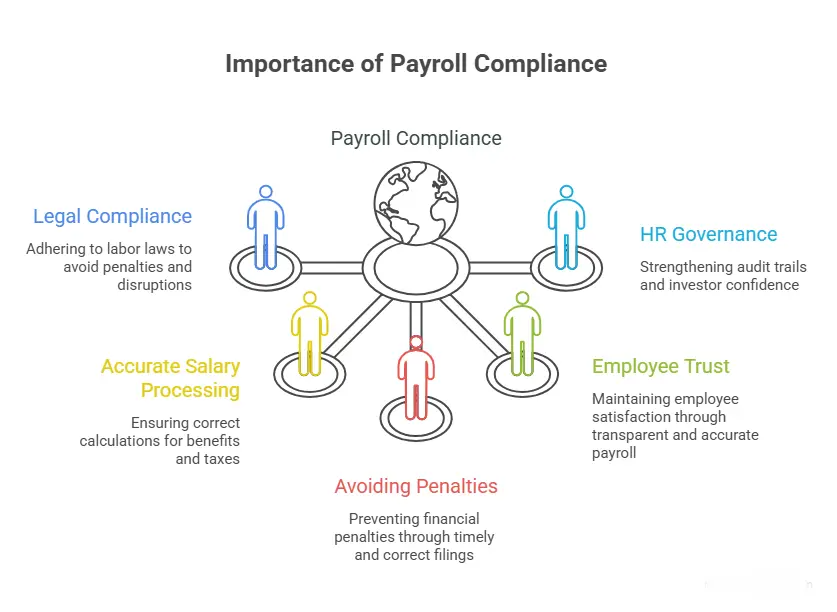
Legal Compliance With Labour Laws
Every company must align with labour laws such as the Payment of Wages Act and minimum wage regulations. Non-compliance can trigger inspections, notices, or even business disruption.
For example, a manufacturing company paying below state minimum wages may face penalties and forced back-pay obligations.
Accurate Salary Processing
Payroll compliance ensures calculations are not just correct—but legally valid. Rules like the 50% wage definition directly impact PF, gratuity, and bonus calculations.
A misclassified salary structure can increase long-term liabilities without the company realizing it.
Avoiding Penalties
Late or incorrect filings attract financial penalties. According to TDS penalty guidelines, delays in tax deposits can accumulate interest monthly.
In one audit case, a startup delayed PF payments for 6 months. The interest and damages exceeded the original contribution amount.
Employee Trust
Payroll transparency affects retention. Employees expect accurate deductions and timely filings.
Incorrect PF or TDS calculations often lead to dissatisfaction, especially during tax filing season.
HR Governance
A compliant payroll system creates a strong audit trail. During due diligence or funding rounds, payroll compliance is often one of the first areas investors review.
Key Components of Payroll Compliance in India
Payroll compliance in India includes several interconnected components:
- Salary structure (Basic, DA, allowances)
- Social security contributions (PF, ESI, LWF)
- Tax deductions (TDS)
- Employee benefits (bonus, gratuity)
- Documentation and reporting
Each component must align with statutory rules. Missing even one layer can result in compliance failure.
Major Payroll Compliance Laws in India
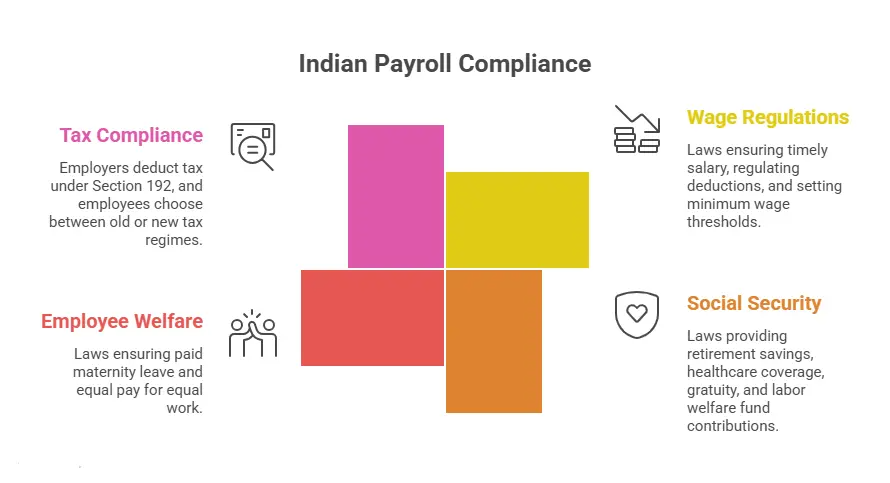
Wage and Salary Regulations
Payment of Wages Act, 1936
This law ensures timely salary payment and regulates deductions. Learn more via Payment of Wages Act guide.
Key provisions:
- Salary must be paid within defined timelines
- Deduction cap: 50%
- Payments through bank or approved methods
Minimum Wages Act, 1948
This law sets minimum wage thresholds across industries and states.
Example: A company operating in multiple states must track different wage rates for each location.
Payment of Bonus Act, 1965
Employees are entitled to profit-linked bonuses.
- Eligibility: Salary up to ₹21,000
- Bonus range: 8.33% to 20%
More details in bonus act explanation.
Social Security Laws
EPF Act, 1952
Provident Fund builds retirement savings.
Example: If an employee earns ₹15,000 basic salary, ₹1,800 is deducted monthly toward PF.
ESI Act, 1948
Provides healthcare coverage.
Example: For a ₹20,000 salary:
- Employee contribution = ₹150
- Employer contribution = ₹650
Payment of Gratuity Act, 1972
Gratuity is paid after 5 years of service.
Example: An employee with ₹30,000 salary and 5 years tenure receives ~₹86,538.
See gratuity guide for formula details.
Labour Welfare Fund
LWF varies by state and requires periodic contributions. Refer LWF overview.
Employee Welfare Laws
Maternity Benefit Act, 1961
Provides paid maternity leave.
- 26 weeks leave
- Employer bears full cost
More in the maternity benefit act guide.
Equal Remuneration Act, 1976
Ensures equal pay for equal work. Explained in equal remuneration act summary.
Tax Compliance
TDS
Employers deduct tax under Section 192. Refer Income Tax Department guide.
Old vs New Tax Regime
Employees choose between:
- Old regime (with deductions)
- New regime (lower rates)
This choice directly affects monthly payroll calculations.
Statutory Payroll Deductions in India
| Component | Employee Contribution | Employer Contribution | Applicability |
| PF | 12% | 12% | Basic ≤ ₹15,000 |
| ESI | 0.75% | 3.25% | Salary ≤ ₹21,000 |
| PT | State-based | – | State laws |
| TDS | As per slab | – | Taxable income |
Example scenario:
An employee earning ₹18,000:
- PF applicable
- ESI applicable
- PT applicable (state-based)
- TDS depends on annual income
PF must be deposited by the 15th of next month. Details in compliance checklist.
Payroll Compliance Checklist for HR Teams
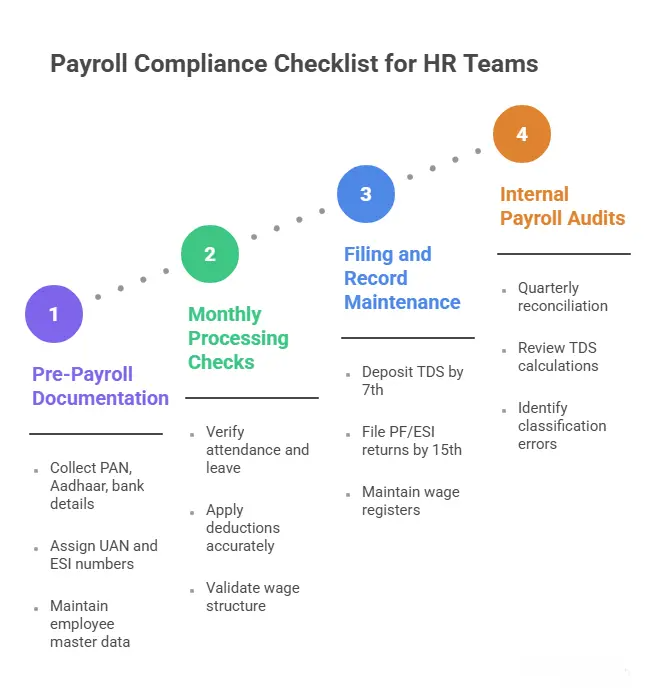
Pre-Payroll Documentation
- Collect PAN, Aadhaar, bank details
- Assign UAN and ESI numbers
- Maintain employee master data
Monthly Processing Checks
- Verify attendance and leave
- Apply deductions accurately
- Validate wage structure
Filing and Record Maintenance
- Deposit TDS by 7th
- File PF/ESI returns by 15th
- Maintain wage registers
Internal Payroll Audits
- Quarterly reconciliation
- Review TDS calculations
- Identify classification errors
Payroll Compliance Filing and Due Dates
| Compliance | Frequency | Due Date |
| TDS | Monthly | 7th |
| PF | Monthly | 15th |
| ESI | Monthly | 15th |
| PT | Monthly/Quarterly | Varies |
| Form 16 | Annual | June 15 |
Missing deadlines is one of the most common compliance failures.
Penalties for Payroll Non-Compliance in India
| Violation | Penalty | Consequence |
| PF delay | 12% interest + damages | Legal action |
| ESI delay | Interest | Prosecution |
| TDS delay | 1.5% per month | Notices |
According to payroll penalty insights, repeated defaults can escalate into legal proceedings.
Common Payroll Compliance Challenges
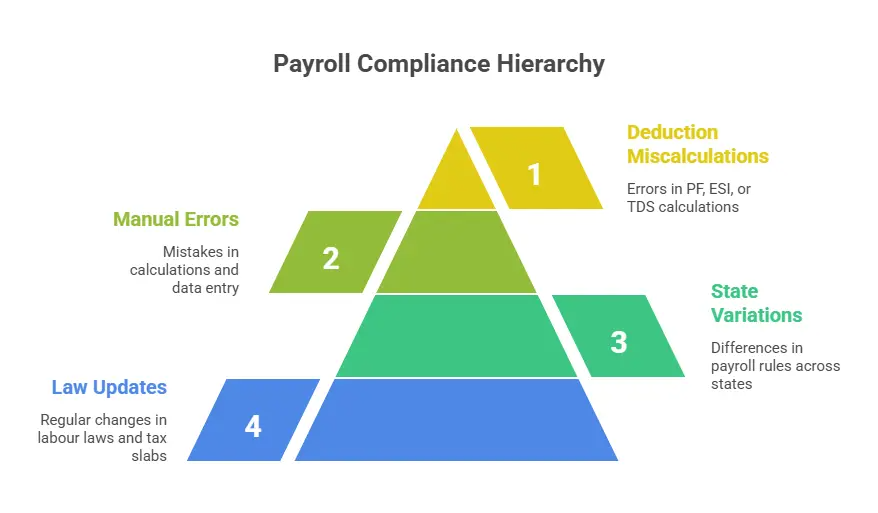
Frequent Law Updates
Labour laws, tax slabs, and compliance thresholds change regularly. HR teams need to continuously track updates and adjust payroll processes, or they risk applying outdated rules that lead to non-compliance.
State-level Variations
Payroll rules like Professional Tax and Labour Welfare Fund differ across states. Companies operating in multiple locations must manage different rates, due dates, and filings, which increases complexity.
Manual Payroll Errors
Spreadsheet-based payroll often leads to mistakes in calculations, data entry, or formula application. Even small errors can impact employee salaries and statutory filings.
Incorrect Deduction Calculations
Miscalculating PF, ESI, or TDS due to wrong wage definitions or outdated thresholds can create compliance gaps. These errors often go unnoticed until audits or government notices.
In SMEs, most issues arise from spreadsheet-based payroll systems.
Best Practices to Ensure Payroll Compliance
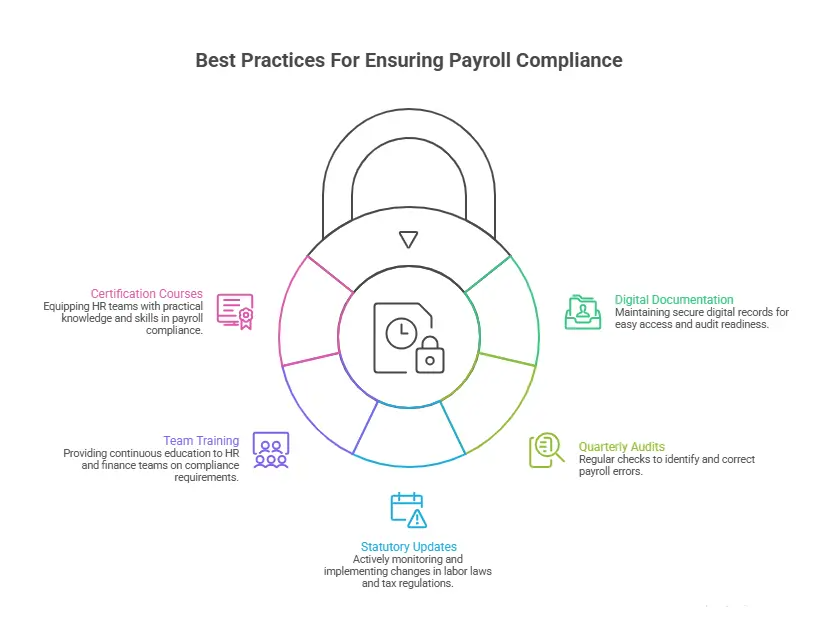
Maintain Digital Documentation
Store all payroll records such as employee data, salary structures, and statutory filings in a secure digital format. This ensures easy access during audits and reduces the risk of missing or lost records.
Conduct Quarterly Audits
Regular payroll audits help identify errors in deductions, filings, or classifications before they become serious compliance issues. It also ensures that processes remain aligned with current laws.
Track Statutory Updates
Labour laws and tax regulations change frequently, and missing an update can lead to incorrect payroll processing. HR teams must actively monitor notifications and revise payroll rules accordingly.
Train Payroll Teams Regularly
Continuous training ensures that HR and finance teams understand evolving compliance requirements. This reduces dependency on external consultants and improves internal accuracy.
Invest In A Payroll Certification cCourse
A structured payroll certification course equips HR teams with practical knowledge of statutory calculations, filings, and compliance workflows. This reduces reliance on trial-and-error approaches and helps ensure accuracy, consistency, and timely compliance across payroll processes.
In my experience, companies that treat payroll like a checklist system rarely face compliance issues.
How a Payroll Certification Course Helps with Compliance
A structured payroll certification course strengthens compliance capability through:
Concept Clarity On Statutory Laws
A certification program builds a strong foundation in PF, ESI, PT, TDS, and labour laws. This helps professionals understand not just what to calculate, but why each compliance rule exists, reducing dependency on guesswork.
Practical Compliance Workflows
Good courses simulate real payroll scenarios such as salary structuring, monthly processing, and statutory filings. This prepares learners to handle end-to-end compliance tasks confidently in actual job roles.
Up-To-Date Legal Knowledge
Certification programs are regularly updated with the latest labour law changes and tax rules. This ensures learners stay aligned with current compliance requirements instead of relying on outdated practices.
Audit And Error Identification Skills
Training includes identifying common payroll mistakes, reconciliation issues, and compliance gaps. This enables professionals to catch errors early and avoid penalties during audits.
Future of Payroll Compliance in India
Payroll is shifting toward digital and centralized systems. As explained in labour code updates, new reforms aim to simplify compliance across India.
Key trends:
- Unified labour portals
- Automated filings
- Real-time compliance tracking
Conclusion
Payroll compliance in India is a structured system that requires accuracy, consistency, and awareness of legal changes. Businesses that build strong processes and adopt automation are better positioned to avoid penalties and maintain stability.
If you’re looking to build practical expertise in handling PF, ESI, TDS, and end-to-end payroll compliance, it’s worth investing in structured learning. A hands-on Payroll Compliance Course can help you move beyond theory and confidently manage real-world payroll scenarios.
Master statutory compliance, avoid costly mistakes, and become a job-ready payroll professional.
Frequently Asked Questions (FAQs)
1. What Is Payroll Compliance In India?
It refers to following all laws related to employee salaries, deductions, and tax filings.
2. What Are Statutory Deductions?
PF, ESI, PT, and TDS are mandatory deductions under Indian law.
3. What Happens If PF Is Not Paid On Time?
Interest, penalties, and legal action may apply.
4. Is Professional Tax Applicable In All States?
No, it varies depending on state laws.
5. How Can HR Teams Ensure Compliance?
By conducting audits, using payroll software, and staying updated on laws.
6. What Is Form 16?
It is a TDS certificate issued annually to employees.