
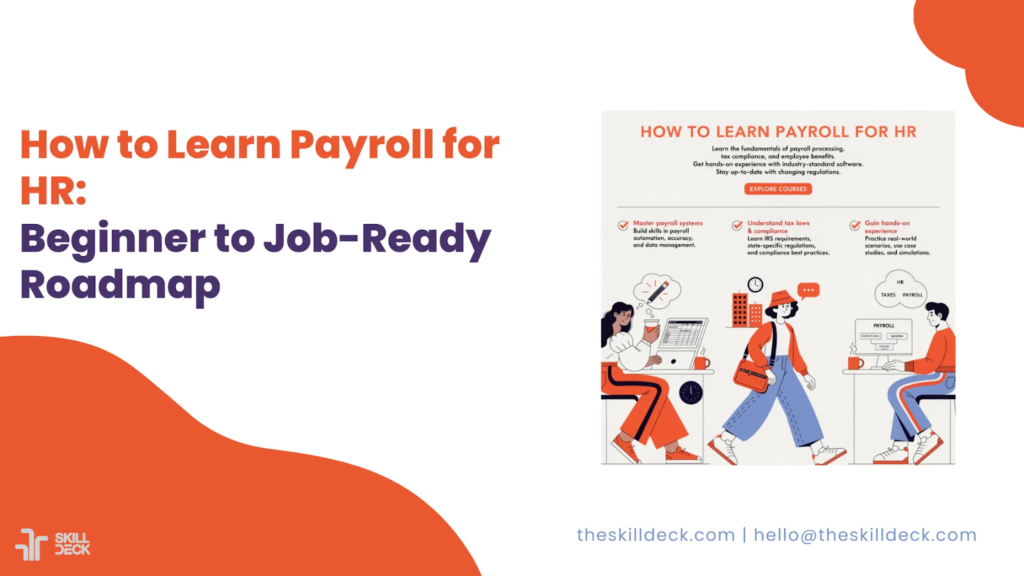
Payroll is often treated as a back-office task, yet data from Indian HR hiring trends and payroll service providers shows a steady rise in demand for payroll-skilled professionals across sectors. As organizations scale and compliance requirements tighten, payroll accuracy directly affects employee trust, legal standing, and cost control.
After years of working with payroll teams, auditing live payroll processes, and training HR professionals, one pattern stands out. Most beginners struggle not because payroll is complex, but because they learn it without structure. Industry observations and hiring patterns show that freshers often focus only on calculations, even though real payroll work in India covers salary structuring, attendance and leave management, statutory compliance like PF, ESI, Professional Tax, and TDS, along with disciplined monthly processing.
This guide is written to give HR payroll freshers, working professionals, career switchers, and small business owners a clear, India-focused roadmap. It follows the same learning sequence used by payroll teams in real organizations, helping learners move from beginner level to job-ready payroll professional with confidence.
Why Learning Payroll Needs a Roadmap
Payroll looks simple on the surface. A salary gets credited every month, and deductions appear on the payslip. Behind that payslip sits a chain of activities that must work perfectly. Attendance data flows into payroll, salary structures determine tax impact, statutory deductions must match government rules, and reports must reconcile with finance records.
In training and hiring payroll professionals, I have seen that candidates who follow a structured payroll learning roadmap become job-ready faster. They understand not only what to calculate, but why each step exists. This clarity helps them handle audits, employee queries, and compliance checks with confidence.
Step-by-Step Payroll Learning Stages (India-Focused Roadmap)
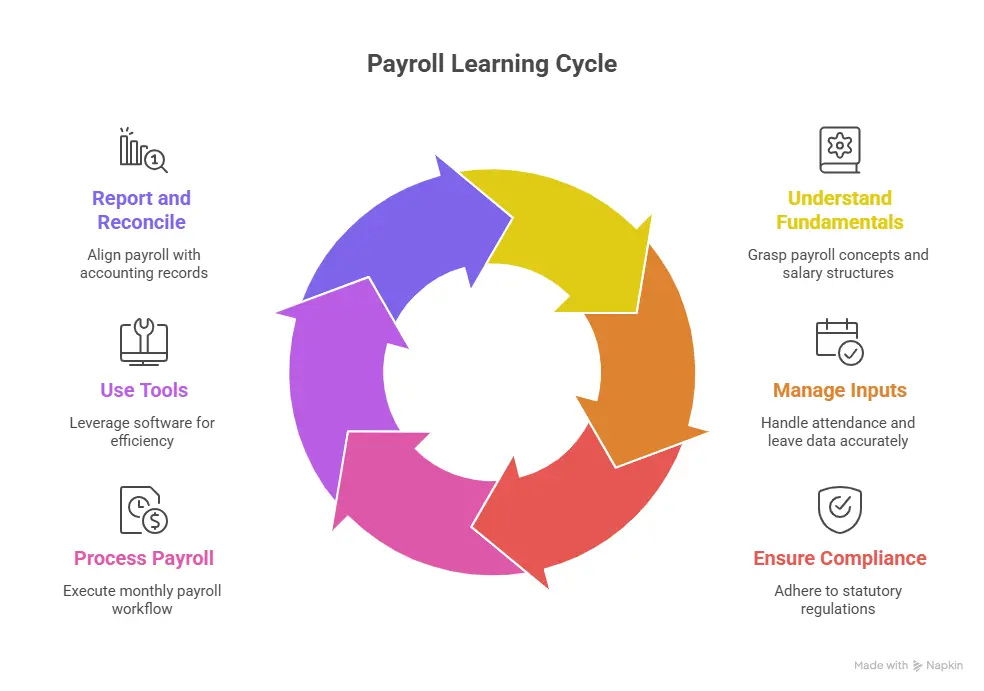
This section breaks the payroll learning journey into clear, progressive stages. Each stage builds on the previous one, following how payroll is actually handled in Indian organizations—from understanding fundamentals to managing compliance, systems, and reporting.
Stage 1: Understanding Payroll Fundamentals
What Payroll Means in HR (India Context)
In the Indian context, payroll in HR is the structured process of calculating, validating, and disbursing employee compensation in line with labour laws, tax regulations, and internal company policies. It is not limited to salary payment. It includes wage definition, attendance linkage, statutory applicability checks, reporting, and audit readiness.
In Indian organizations, payroll sits at the intersection of HR, finance, and compliance. Errors in any part of this chain can lead to statutory penalties, employee disputes, or audit observations.
At this stage, learners should clearly understand:
- What constitutes wages under Indian payroll practices
- Difference between CTC, gross salary, taxable income, and net pay
- Monthly payroll cycles, cut-off dates, and processing timelines
- Division of responsibility between HR, payroll, finance, and external vendors
Salary Structure Basics as Practiced in India
Salary structuring is the foundation of compliant payroll processing in India. Components such as basic salary, HRA, special allowance, employer and employee statutory contributions, and reimbursements must be structured carefully to meet legal definitions and tax treatment.
HR professionals learning payroll should focus on:
- How basic salary percentage impacts PF contribution
- How allowances affect taxable income
- Why incorrect structuring leads to compliance gaps or employee dissatisfaction
Understanding salary structure logic early helps learners read payslips accurately, explain deductions to employees, and manage salary revisions without errors.
For taxation concepts and salary component treatment, learners should refer to official guidance published by the Income Tax Department of India, which outlines salary taxation, exemptions, deductions, and Form 16 requirements.
Stage 2: Attendance, Leave, and Input Management
Attendance Systems and Payroll Impact (India Practice)
Attendance and leave data form the primary input layer of Indian payroll processing. Most payroll errors originate from incorrect or unverified attendance data rather than calculation logic. Time office records, biometric systems, and attendance registers directly affect loss of pay, overtime, shift allowances, and statutory wage calculations.
HR payroll learners should clearly understand:
- Attendance cut-off dates followed by organizations
- Treatment of late marks, half-days, and weekly offs
- Flow of overtime and shift allowances into payroll
Payroll teams are expected to validate attendance data before payroll runs, not after salary credit.
Leave Policies and Payroll Linkage
Leave policies must be interpreted correctly within payroll. Paid leave, unpaid leave, carry forward rules, and leave encashment affect salary payout and statutory calculations.
Learners should focus on:
- Difference between paid leave and loss of pay
- Impact of excess leave on PF and ESI wages
- Handling leave encashment during exits
At this stage, learners should practice preparing attendance and leave input sheets using Excel, following real organizational timelines, before moving to payroll systems.
Stage 3: Statutory Compliance in Indian Payroll
Statutory compliance is the highest-risk area in Indian payroll. Employers expect payroll professionals to understand applicability rules, contribution logic, due dates, and reporting formats.
Provident Fund (PF)
Employees’ Provident Fund applies based on wage definitions under EPF law. Payroll professionals must understand PF wage components, contribution percentages, and filing requirements as prescribed by the Employees’ Provident Fund Organisation (EPFO).
Key focus areas include:
- PF applicability and employee eligibility
- Difference between PF wages and gross salary
- Monthly ECR filing and challan generation through the EPFO portal
Employee State Insurance (ESI)
ESI applicability depends on wage thresholds and establishment coverage under ESI law. Payroll professionals are responsible for accurate contribution calculation, payments, and return filing as per guidelines issued by the Employees’ State Insurance Corporation (ESIC).
Learning points include:
- ESI wage ceiling and contribution rates
- Handling wage changes during contribution periods
- Filing timelines and contribution reconciliation
Professional Tax (PT)
Professional Tax rules are state-specific. Frequent errors occur due to incorrect slab application and delayed payments. Payroll learners must refer to notifications issued by their respective State Commercial Tax or Labour Department websites for accurate slabs and due dates.
Learners must understand:
- State-wise PT slabs as notified by authorities
- Monthly or annual payment cycles
- Exemption handling
Tax Deducted at Source (TDS)
TDS links payroll with income tax compliance. Payroll professionals calculate tax based on declarations, exemptions, deductions, and applicable slabs notified by the Income Tax Department.
Learners should understand:
- Investment declaration processing
- Monthly TDS deduction and deposit
- Form 16 preparation and annual reconciliation
Strong compliance knowledge supports audits and avoids penalties.
Stage 4: Payroll Processing Cycle
Payroll processing follows a structured monthly workflow rather than a single calculation step. Each stage must follow a defined sequence.
Monthly Payroll Flow in Indian Organizations
A standard payroll cycle includes:
- Finalizing attendance and variable inputs
- Validating employee master and salary structures
- Calculating statutory deductions and taxes
- Reviewing payroll reports and exceptions
- Generating payslips and salary files
- Salary disbursement and statutory payments
Practicing this full cycle prepares learners for live payroll roles.
Common Payroll Errors to Watch
Errors commonly arise from outdated compliance rates, incorrect wage definitions, and weak validation controls. Payroll professionals are expected to review data before final approval.
Stage 5: Payroll Tools and Software
Tools support payroll logic but do not replace it. Strong payroll professionals understand processes before systems.
Excel as a Payroll Learning Tool
Excel remains the primary learning tool for payroll beginners. It supports salary structuring, validation, and reconciliation.
Key Excel skills include:
- Salary calculation templates
- Validation checks
- Statutory models
Payroll and HRMS Software Exposure
Most organizations use payroll or HRMS systems. Learners should understand system workflows even without live access.
Focus areas include:
- Employee master setup
- Payroll processing cycles
- Payslip and report generation
Stage 6: Payroll Accounting and Reporting
Payroll responsibilities extend beyond salary credit into accounting and reporting. Payroll outputs must align with finance records and statutory submissions.
HR payroll professionals should learn:
- Payroll journal entries and cost allocation
- Bank and ledger reconciliation
- Statutory registers and audit documentation
Payroll Learning Roadmap Summary
| Learning Stage | Focus Areas | What You Should Be Able to Do |
| Stage 1: Payroll Fundamentals | Salary components, CTC vs gross vs net | Read and explain payslips with confidence |
| Stage 2: Attendance & Leave | Attendance inputs, LOP, leave rules | Prepare accurate monthly payroll inputs |
| Stage 3: Statutory Compliance | PF, ESI, PT, TDS | Calculate deductions and meet statutory timelines |
| Stage 4: Payroll Processing | End-to-end monthly cycle | Run a complete payroll process without supervision |
| Stage 5: Tools & Software | Excel, payroll systems | Process payroll data using tools and reports |
| Stage 6: Accounting & Reporting | Journals, reconciliation, audits | Support finance teams and payroll audits |
Skills That Make You Job-Ready in Payroll
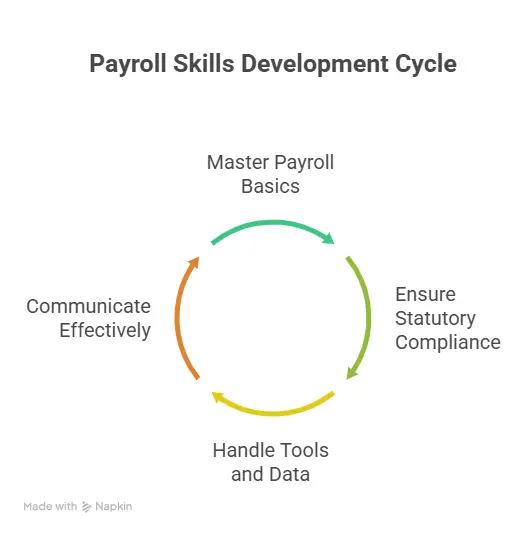
Becoming job-ready in payroll depends on applying skills in real situations. Recruiters look for professionals who can link payroll data with compliance, communication, and reporting.
Payroll Basics
- Understand salary structures and their impact on take-home pay
- Handle arrears, bonuses, incentives, and full-and-final settlements
- Explain payslips clearly to employees
Statutory Compliance Handling
- Calculate PF, ESI, PT, and TDS accurately
- Track filing timelines and rule updates
- Manage joiners, exits, and salary revisions correctly
Tool and Data Handling Skills
- Validate and reconcile payroll data in Excel
- Identify errors before payroll processing
- Work comfortably with payroll or HRMS systems
Employee and Stakeholder Communication
- Respond to salary and tax queries clearly
- Coordinate with HR and finance teams
- Reduce escalations through clear explanations
These skills show that you can manage payroll responsibilities independently and support audits with confidence.
| Skill Area | What Recruiters Expect |
| Payroll Basics | Clear understanding of salary structures |
| Compliance | Accuracy in PF, ESI, PT, and TDS |
| Tools | Comfort with Excel and payroll systems |
| Communication | Handling employee payroll queries |
How Long It Takes to Learn Payroll
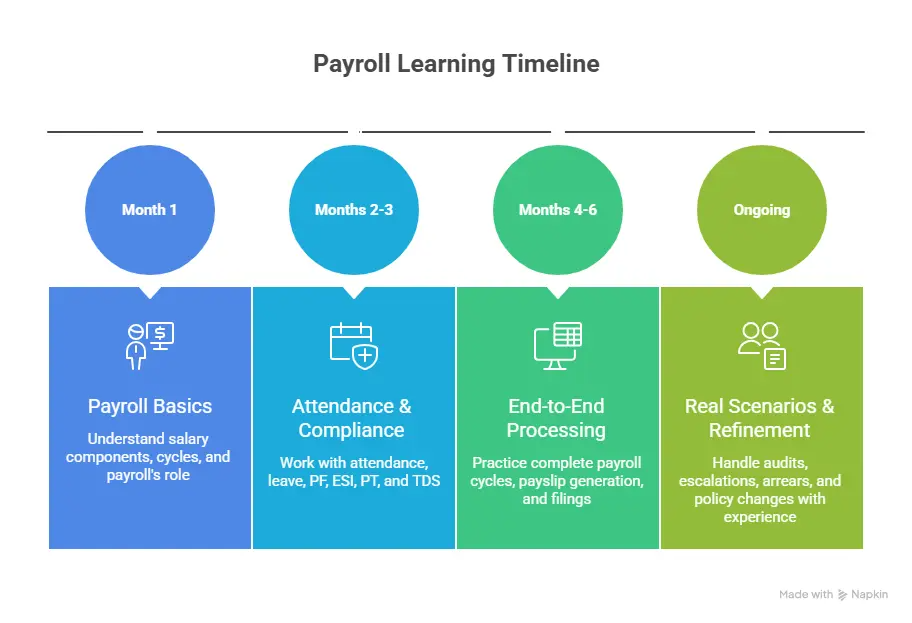
The time required to learn payroll depends on how structured your approach is and how much practical exposure you get. For most beginners, payroll learning happens in phases.
First 1 Month: Payroll Basics
At this stage, learners focus on understanding salary components, CTC vs gross vs net salary, payroll cycles, and the overall role of payroll within HR and finance. The goal is clarity, not speed.
Month 2 to 3: Attendance, Compliance, and Inputs
Learners start working with attendance data, leave rules, loss of pay calculations, and statutory concepts like PF, ESI, PT, and TDS. This phase builds confidence in compliance logic and monthly payroll inputs.
Month 4 to 6: End-To-End Payroll Processing
With fundamentals in place, learners practice complete payroll cycles, including validations, payslip generation, salary disbursement coordination, and statutory filings. Exposure to Excel-based payroll and payroll software strengthens job readiness.
Ongoing: Real Scenarios And Refinement
Payroll learning does not stop after six months. Handling audits, inspections, employee escalations, arrears, and policy changes comes with experience. Continuous practice shortens the learning curve and improves accuracy.
With a structured roadmap and consistent practice, beginners typically reach working-level payroll competence within three to six months.
Common Mistakes Beginners Should Avoid
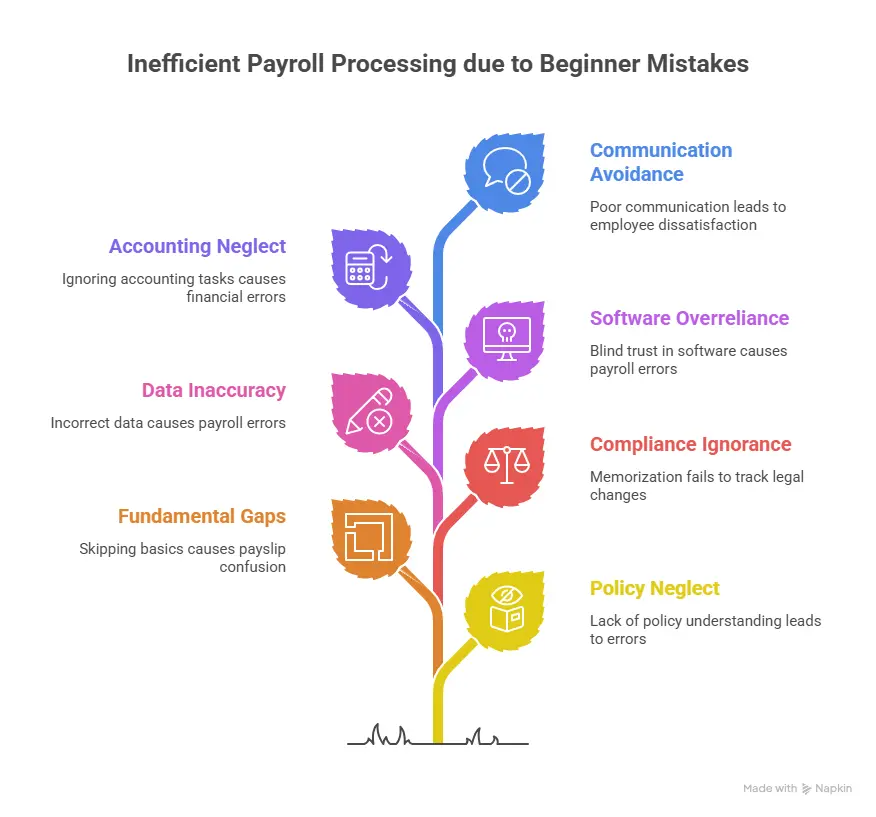
- Focusing only on calculations and software screenshots instead of understanding payroll policies, timelines, and checks.
- Skipping payroll fundamentals such as salary structures, CTC logic, and payroll cycles, which leads to confusion when explaining payslips or handling salary changes.
- Treating statutory compliance as memorisation rather than tracking notifications, circulars, and due dates.
- Ignoring attendance and input accuracy, including missed leave entries, incorrect LOP, or unverified variable pay.
- Overdependence on payroll software without understanding payroll logic behind the system.
- Ignoring payroll accounting tasks such as journals, bank reconciliation, and statutory matching.
- Avoiding employee communication related to salary, tax, and deduction queries.
Avoiding these mistakes shortens the learning curve and helps payroll learners transition into job-ready professionals faster.
Career Opportunities After Learning Payroll
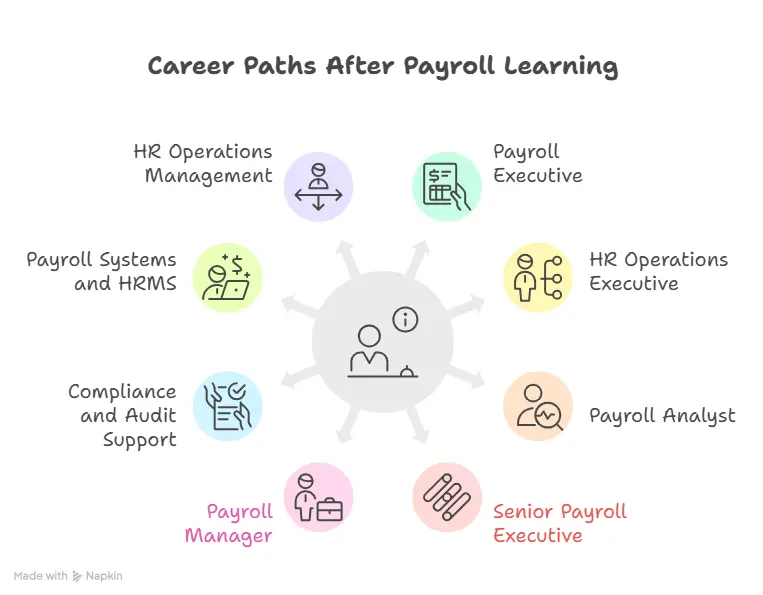
Payroll skills support multiple career paths across industries such as IT, manufacturing, healthcare, retail, BFSI, startups, and payroll outsourcing firms. Each role builds on the same foundation, with responsibility increasing through experience and exposure.
Payroll Executive / Payroll Assistant
This is the most common entry point for beginners. The role focuses on executing routine payroll activities under supervision.
Key responsibilities include preparing attendance and salary inputs, processing monthly payroll data, generating payslips, and assisting with PF, ESI, PT, and TDS calculations. Professionals in this role learn how payroll timelines work and how small input errors affect final salary outcomes.
This role suits HR freshers, finance graduates, and career switchers starting their payroll journey.
HR Operations Executive – Payroll
This role blends payroll with broader HR operations. Along with payroll inputs and processing support, professionals coordinate with attendance teams, HR business partners, and employees.
Responsibilities include handling employee payroll queries, supporting onboarding and exit payroll activities, and maintaining employee payroll records. This role builds strong process discipline and communication skills.
Payroll Analyst / Payroll Specialist
With experience, professionals move into analytical roles. These positions involve owning end-to-end payroll processing for assigned units or locations.
Responsibilities include validating payroll data, handling statutory filings, resolving complex payroll cases, coordinating with finance teams, and supporting internal or external audits. Accuracy, compliance awareness, and reporting skills are closely observed at this stage.
Senior Payroll Executive / Payroll Lead
Senior roles focus on oversight and control. Professionals supervise payroll teams, review payroll outputs, and ensure compliance consistency across locations.
Responsibilities include approving payroll runs, managing escalations, coordinating inspections, and improving payroll processes. Exposure to audits, policy interpretation, and stakeholder management increases significantly.
Payroll Manager
Payroll Managers take ownership of the entire payroll function. They manage teams, vendors, timelines, and compliance strategy.
This role involves managing multi-location or high-volume payrolls, leading statutory audits, coordinating with senior HR and finance leaders, and ensuring payroll governance. Strategic thinking and risk control become key expectations.
Compliance and Audit Support Roles
Some professionals move into focused compliance roles. These positions deal with statutory inspections, payroll audits, and regulatory reporting.
Work includes preparing audit data, responding to notices, tracking legal updates, and supporting organizations during compliance reviews. This path suits professionals who enjoy detail-driven work.
Payroll Systems and HRMS Roles
Professionals with interest in systems transition into payroll technology roles. Responsibilities include payroll software implementation, system configuration, testing, and data migration.
This path suits those who combine payroll knowledge with system understanding and process improvement skills.
HR Operations Management and Global Payroll Roles
Payroll experience supports growth into HR operations leadership and shared services roles. In multinational organizations, professionals may move into global payroll coordination roles, working with international vendors and compliance teams.
Over time, strong payroll professionals become trusted custodians of employee compensation and compliance, making payroll a stable and respected long-term HR career choice.
Final Thoughts and Next Steps
Learning payroll is a practical journey. After years of training payroll professionals, one thing is clear. A step-by-step roadmap turns beginners into confident professionals faster than scattered learning. Start with fundamentals, build compliance knowledge, practice real payroll cycles, and stay updated with legal changes.
For readers serious about payroll careers, the next step is guided practice through structured training, live payroll scenarios, and continuous learning from official statutory sources. Payroll done right builds trust, and trust builds strong HR careers.