

Talent acquisition has moved well beyond posting jobs and screening resumes. Modern recruiters are expected to understand sourcing technology, workforce planning, employer branding, recruitment analytics, structured interviewing, and AI-assisted hiring. That shift is one reason searches for a talent acquisition course online increasingly focus on practical training rather than a certificate alone.
The right course should help you perform the work recruiters handle every day. When comparing programs, look closely at five areas:
- Live instruction
- Practical training
- Curriculum depth
- Projects
- Certification.
Career support also matters if your goal is to move into a recruiter or talent acquisition role.
A good program should leave you with more than notes and a downloadable certificate. You should be able to demonstrate sourcing skills, ATS workflows, candidate evaluation, recruitment metrics, and practical hiring decisions.
Why Learn Talent Acquisition Online?
The recruitment profession has shifted from a reactive staffing activity to a broader talent acquisition function connected to business planning. Traditional recruitment often starts after a vacancy appears. Talent acquisition can involve workforce planning, talent mapping, employer branding, proactive sourcing, structured assessment, and recruitment analytics before and after a role opens.
Online learning also fits the way modern recruitment is performed. Recruiters already work through cloud ATS platforms, professional networks, digital scheduling systems, sourcing tools, and analytics platforms. Practising these workflows online can closely reflect the digital environment used in corporate hiring teams.
Recruitment vs Talent Acquisition: What’s the Difference?
Recruitment and talent acquisition overlap, but their scope is different.
A recruiter working in a tactical recruitment model may receive an approved vacancy, publish a job, review applications, conduct initial screening, coordinate interviews, and support the offer process.
Talent acquisition takes a longer-term approach. It can include workforce planning, defining role requirements, building passive candidate pipelines, employer branding, structured assessment, stakeholder management, and recruitment funnel analysis.
For example, imagine a technology company expects to hire fifty software professionals over the next year. In traditional recruitment the search for new recruits begins once each vacancy is approved.
But as a talent acquisition professional you will have the knowledge to study the workforce plan, identify the skills required, map the available talent market, build candidate pipelines, and develop a sourcing strategy before all the positions become active.
That difference explains why a modern talent acquisition curriculum needs to cover both recruitment execution and strategic workforce activities.
Why Talent Acquisition Is One of HR’s Fastest-Growing Skills
There is a rising demand for skilled talent acquisition professionals. The Chartered Institute of Personnel and Development reports that 52% of organizations say competition for qualified talent has intensified, while 64% of recruiting organizations continue to face candidate attraction challenges. The same research reports that 46% of organizations still use an ad hoc approach to resourcing, while only 19% formally measure recruitment ROI.
India also has a strong connection to this trend through the growth of Global Capability Centers (GCCs). Mavins Advilogy projects India’s staffing and talent ecosystem to reach $48.5 billion by 2030, with a projected 13.2% compound annual growth rate. GCCs are projected to create between 425,000 and 450,000 high-value professional roles annually.
These market changes place high value on skills like technical sourcing, Boolean search, ATS usage, recruitment analytics, and AI-assisted recruitment.
So…
Who Should Take a Talent Acquisition Online Course?
A talent acquisition online course can suit several types of learners:
- HR freshers who want practical recruitment skills before applying for their first HR role.
- Recruiters who want to move beyond basic job-board sourcing and develop advanced sourcing capabilities.
- HR executives who want stronger exposure to workforce planning, analytics, employer branding, and structured assessment.
- Career switchers from sales, customer service, administration, operations, or other fields who have transferable communication and relationship-management skills but need recruitment-specific knowledge.
The research also identifies sales and customer-service professionals as potential career switchers because skills such as active listening, relationship management, objection handling, and persuasive communication can transfer into talent acquisition. Technical gaps can then be addressed through training in Boolean search, ATS operations, structured interviewing, and recruitment analytics.
What Should You Look for in the Best Talent Acquisition Course Online?
When comparing a talent acquisition course online, focus on what you will actually be able to do after completing it.
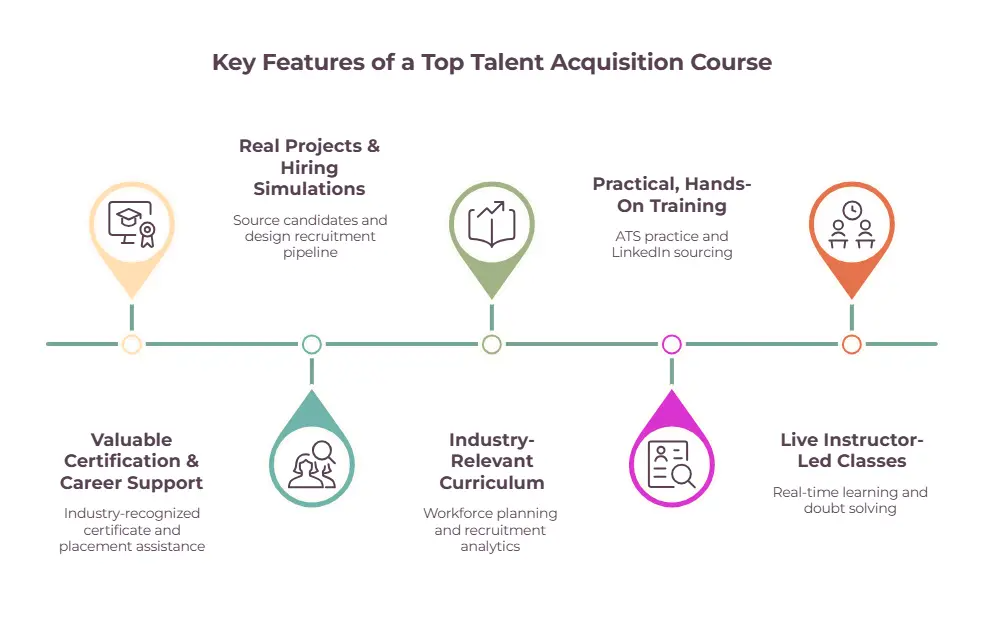
Live Instructor-Led Classes
Recruitment involves judgement, communication, and repeated problem-solving. A live class gives learners the opportunity to ask questions, receive immediate feedback, and practise recruitment situations with an instructor and other learners.
For example, a learner may create a Boolean search that returns too many irrelevant profiles. In a live session, an instructor can identify the issue and adjust the search logic in real time. The same format can be used for hiring-manager intake meetings, candidate screening, behavioural interviews, and compensation discussions.
Hyring’s study show a completion rates of 70%–85% for live cohort programs, compared with 5%–15% for asynchronous MOOC platforms. Scheduled sessions, peer interaction, and instructor access create accountability that can help learners stay engaged.
Practical, Hands-On Training
A recruiter needs to work with recruitment technology, not just understand its terminology.
Look for an online recruiter course that provides practical exposure to:
- Applicant Tracking Systems (ATS)
- LinkedIn sourcing
- Boolean search
- Candidate screening
- Interview coordination
- Candidate pipeline management
- Recruitment reporting
A strong ATS exercise might involve creating a requisition, moving candidates through hiring stages, recording candidate communication, and working with interview scorecards. Sourcing practice can involve LinkedIn filters, Boolean operators, X-Ray searches, and personalised outreach.
The research identifies platforms such as Greenhouse, Lever, Workday, and LinkedIn Recruiter as useful environments for practical recruitment training.
Industry-Relevant Curriculum
A modern curriculum should cover the complete hiring lifecycle rather than stopping at job posting and resume screening.
Key areas include:
- Workforce planning
- Job analysis
- Candidate sourcing
- LinkedIn sourcing
- Boolean search
- Passive candidate engagement
- Structured interviewing
- Employer branding
- Candidate experience
- Recruitment analytics
- AI in recruitment
- Recruitment compliance
The research divides modern TA training into four broad areas: strategic foundations, advanced sourcing, assessment and stakeholder management, and recruitment operations and governance.
Real Projects & Hiring Simulations
Projects turn knowledge into demonstrable work.
A useful hiring simulation could begin with a hiring-manager intake meeting. The learner then defines the role, creates a skills-focused job description, sources candidates, screens them through an ATS, and presents an offer recommendation.
Other useful assignments include a difficult-to-fill sourcing project, a Boolean and X-Ray search exercise, a structured interview scorecard, and a recruitment funnel analysis.
The research recommends practical portfolio deliverables rather than relying only on multiple-choice quizzes. These deliverables can give candidates something concrete to discuss during interviews.
Valuable Certification & Career Support
A certificate has more value when it represents demonstrated capability.
The research notes that recognised professional bodies such as SHRM, HRCI, and CIPD can add credibility to a qualification. It also points to project-based programs where learners demonstrate practical competence through sourcing, screening, and analytics assignments.
Career support can include:
- Recruiter-focused resume guidance
- LinkedIn profile optimisation
- Mock interviews
- Portfolio reviews
- Employer referral networks
- Interview preparation
These services can help learners translate training into a job-search strategy.
Talent Acquisition Course Comparison Checklist
| Feature | What a Quality Course Should Offer |
| Live instruction | Weekly interactive classes |
| Practical training | ATS + sourcing exercises |
| Curriculum | Complete TA lifecycle |
| Projects | Real hiring simulations |
| Certification | Industry-recognized |
| Career support | Resume & interview guidance |
Use this checklist before enrolling. Get In Touch with the provider to inquire about each feature rather than accepting broad statements such as “practical training” or “career support.”
For example, ask whether ATS training includes actual workflow exercises, whether Boolean search assignments are reviewed by an instructor, and whether projects become portfolio pieces. Also check whether certification requires an assessment or project submission.
A course can have a long syllabus and still provide limited practical exposure. The learning format, instructor access, software practice, project requirements, and career support should all be considered together.
Live Training vs Self-Paced Courses
Both formats can work for different learners.
| Feature | Live Online Course | Self-Paced Course |
| Instructor support | Yes | Limited |
| Practical feedback | Yes | Minimal |
| Accountability | High | Low |
| Networking | Yes | Rare |
| Best for | Job-ready learners | Independent learners |
Live learning gives learners fixed sessions, instructor interaction, peer discussion, and immediate feedback. The research describes live cohort programs as having stronger completion rates and a structured 6–10 week path toward portfolio readiness.
Self-paced learning has a different advantage: flexibility. Learners can study around work or other commitments and return to specific lessons when needed. This format can suit experienced recruiters who want to improve a particular skill without attending scheduled classes.
The choice depends on your current experience, schedule, learning preferences, and career objective.
Essential Modules Every Talent Acquisition Course Should Include
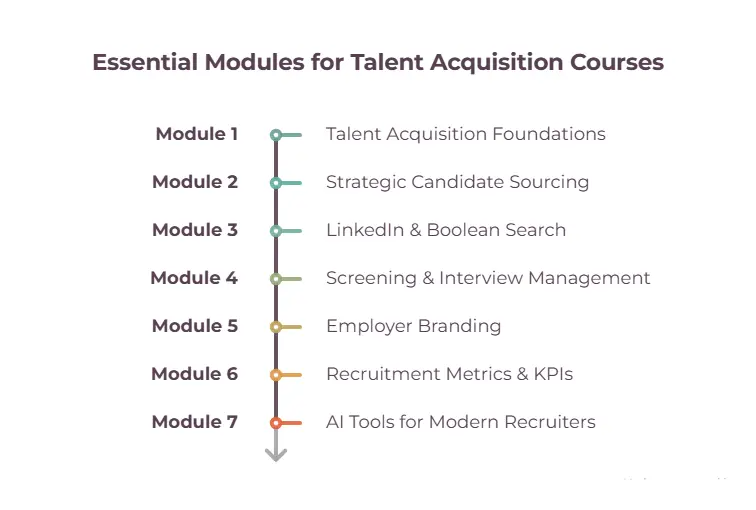
Talent Acquisition Foundations
This module should explain how TA connects hiring activity with business requirements. Learners should understand headcount planning, cost-per-hire, recruitment service-level agreements, internal versus agency recruitment, and the wider talent lifecycle.
A workplace exercise could involve reviewing a company’s growth plan and calculating the expected hiring volume, budget, and sourcing timeline. This gives learners a practical view of why recruitment starts before a vacancy reaches a job board.
Strategic Candidate Sourcing
Candidate sourcing should go beyond collecting applications from job boards. Learners should understand multi-channel sourcing, competitor talent mapping, alumni rediscovery, employee referrals, and open-web sourcing.
A practical assignment could involve creating a sourcing plan for a hard-to-fill position. The learner would identify channels, expected conversions, outreach timing, and candidate segments.
LinkedIn & Boolean Search
LinkedIn sourcing and Boolean search are core technical skills for modern recruiters. Learners should practise search filters, candidate segmentation, InMail, Boolean operators, phrase grouping, and X-Ray searches.
A practical task could require building a LinkedIn pipeline for a specific hiring requirement and creating a Google X-Ray string to find publicly available profiles outside standard platform searches.
Screening & Interview Management
Recruiters need consistent methods for screening and assessing candidates. A course should cover resume review, skills-based shortlisting, structured interviews, STAR-based questions, interview scorecards, and stakeholder coordination.
For example, learners could review 25 resumes against a standardised role rubric and select five candidates for an initial screen. They can then build an interview guide with competency areas and scoring criteria.
Employer Branding
Employer branding affects how candidates perceive an organisation before and during the hiring process. Training should cover the Employee Value Proposition, recruitment marketing, employee advocacy, workplace culture, flexibility, career growth, and candidate expectations.
A practical assignment could involve developing an EVP campaign for a technical hiring requirement and creating candidate-facing content that reflects the organisation’s employment proposition.
Recruitment Metrics & KPIs
Recruiters increasingly need to understand data. A useful recruitment analytics module should cover Time-to-Fill, Time-to-Hire, Cost-per-Hire, stage conversion rates, source quality, offer acceptance, and Quality-of-Hire.
Learners should practise reading recruitment funnel data, identifying candidate drop-off points, calculating hiring costs, and presenting findings through a management dashboard.
AI Tools for Modern Recruiters
AI is now part of many recruitment workflows. Training can cover AI-assisted role profiling, candidate matching, outreach drafting, interview transcript analysis, and sourcing support.
AI should be presented as an operational aid rather than a replacement for recruiter judgement. Recruiters still need to assess candidate fit, manage stakeholder relationships, handle sensitive conversations, and watch for algorithmic bias.
The research reports that recruiters integrating generative AI into their workflows save an average of 20% of their working hours, while also stressing the need for human oversight and careful configuration of automated screening systems.
Why Practical Projects Matter More Than Theory
Recruitment is a performance-based function. Knowing the definition of Boolean search is different from building a Boolean string that produces a useful candidate pool. Understanding an ATS is different from moving candidates through a pipeline while keeping records accurate.
Projects allow learners to practise these tasks in a controlled setting.
A strong talent acquisition certification program can include a hiring simulation, candidate sourcing assignment, ATS workflow project, structured interview scorecard, and recruitment analytics dashboard. These outputs can become part of a portfolio that demonstrates what the learner can actually do.
Skills developed through projects
- Boolean and X-Ray sourcing
- Candidate pipeline building
- ATS workflow management
- Resume screening
- Structured interviewing
- Stakeholder communication
- Recruitment funnel analysis
- Candidate outreach
- Recruitment reporting
- AI-assisted recruitment workflows
The research identifies portfolio artefacts such as sourcing logs, interview scorecards, requisition briefs, and funnel diagnostics as useful evidence of operational capability during recruitment interviews.
How SkillDeck’s Talent Acquisition Course Meets These Standards
SkillDeck can be evaluated against the same criteria rather than simply being selected because it offers a certificate. The wider SkillDeck research describes a live virtual training model, practical software exposure, experienced HR practitioners, and career-focused support. Its Talent Acquisition instruction is associated with practical case studies and interactive problem-solving.
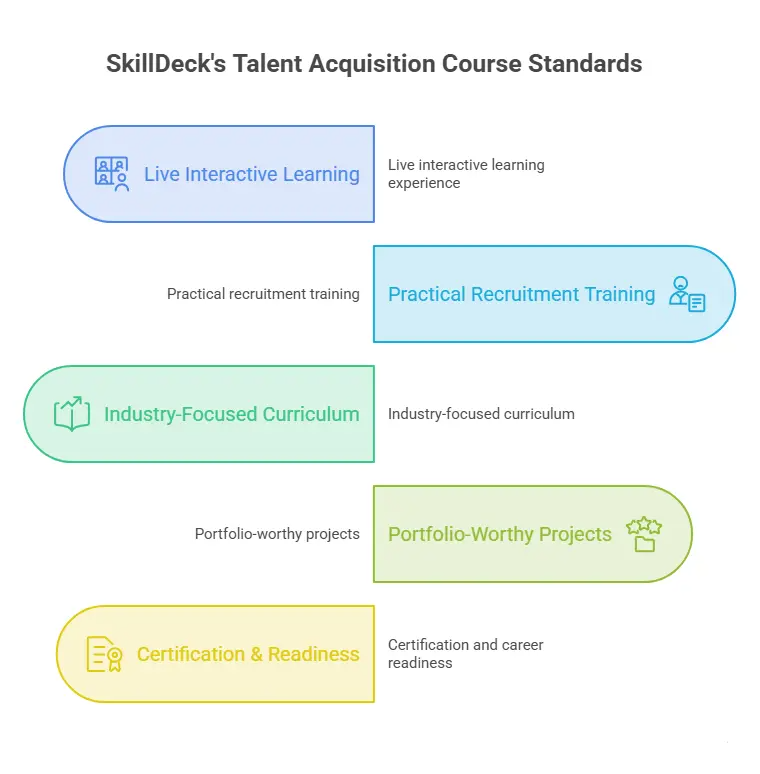
Live Interactive Learning Experience
At Skilldeck’s we conduct live virtual classrooms together with recorded lessons. Our instructors with 15+ years of corporate experience have built learning models for real workplace scenarios that guarantee quick results.
If you want to pursue a talent acquisition online course, then our live classes provide the ideal environment to ask questions, discuss recruitment situations, and receive guidance along with practical training.
Practical Recruitment Training
Skilldeck’s broader HR training model includes hands-on work with recruitment and HR technology, including Zoho Recruit. The research also identifies advanced Boolean logic, LinkedIn Recruiter syntax, AI-supported sourcing, and candidate pipeline tracking as relevant learning needs for recruiters.
That practical focus is useful for learners who want recruitment training connected to day-to-day recruiter workflows rather than a purely theoretical HR curriculum.
Industry-Focused Curriculum
The research behind the course framework covers workforce planning, job analysis, sourcing, LinkedIn Recruiter, Boolean search, candidate assessment, employer branding, recruitment analytics, and generative AI.
This creates a broader learning path than basic recruitment training because learners can study both candidate acquisition and the strategic activities surrounding the hiring lifecycle.
Portfolio-Worthy Projects
Our live Talent Acquisition course framework emphasises practical experience through sourcing exercises, interview scorecards, hiring simulations, and recruitment funnel analysis.
For learners building a portfolio, these projects provide examples to highlight during interviews to demonstrate your familiarity with common recruitment workflows.
Certification & Career Readiness
Our career support apparatus includes LinkedIn profile optimisation, mock technical interviews, ATS-focused resume work, and hiring-partner referrals. We also have the support of more than 1,000 hiring partners.
We encourage our learners to review the exact certification requirements, project components, career-support terms, and current batch details before enrolling.
Career Opportunities After Completing a Talent Acquisition Course
A practical Talent Acquisition Live Program can prepare you for several recruitment and talent acquisition roles. The exact position depends on prior experience, technical knowledge, and the type of hiring organization.
| Job Role | Key Responsibilities | Skills Employers Look For |
| Talent Acquisition Executive | Candidate sourcing, screening, interview coordination and recruitment operations | Sourcing, ATS, communication, screening |
| HR Recruiter | Managing open positions and candidate pipelines | Job portals, Boolean search, candidate engagement |
| Technical Recruiter | Hiring technology professionals and supporting technical recruitment | Technical sourcing, LinkedIn, X-Ray search, candidate assessment |
| Talent Acquisition Specialist | Managing broader recruitment processes and stakeholder interactions | Full-cycle recruitment, interviewing, analytics |
| Recruitment Consultant | Managing client requirements and candidate pipelines | Sourcing, stakeholder management, outreach, negotiation |
The research also identifies Recruiting Coordinator, Talent Sourcing Specialist, Full-Cycle Talent Acquisition Specialist, and Technical Recruiter as career paths associated with structured Talent Acquisition Training.
Employers increasingly look for ATS pipeline management, precision sourcing, recruitment metrics, AI skills, stakeholder communication, candidate engagement, and strong organisation.
Frequently Asked Questions
Which Is The Best Talent Acquisition Course Online?
The right course depends on your background and career objective. Look for live instruction, hands-on ATS and sourcing practice, a complete Talent Acquisition lifecycle curriculum, real hiring projects, meaningful certification, and career support.
A strong program should also cover Boolean search, LinkedIn sourcing, recruitment analytics, employer branding, structured interviews, and AI-assisted recruitment rather than focusing only on basic resume screening.
Is an Online Talent Acquisition Course Worth It?
An online course can be useful when it provides practical training rather than passive video consumption. Modern recruiters already work through digital ATS platforms, sourcing tools, professional networks, and analytics systems, so online learning can replicate many of the environments used at work. Live instruction and practical exercises can add feedback and accountability that self-directed study may not provide.
Can Freshers Learn Talent Acquisition Online?
Yes. Freshers can start with the fundamentals and progress into sourcing, screening, interviewing, ATS workflows, analytics, and AI-supported recruitment. A structured program can also help beginners build practical portfolio pieces that give them examples to discuss during interviews. Entry-level paths identified in the research include Recruiting Coordinator, Junior Sourcing Specialist, Talent Acquisition Associate, Recruitment Operations Specialist, and entry-level in-house recruiter.
What Projects Should A Talent Acquisition Course Include?
Look for projects that resemble actual recruitment work. Useful examples include an end-to-end requisition simulation, targeted candidate sourcing assignment, Boolean and X-Ray search exercise, structured interview scorecard, and recruitment funnel diagnostic. These projects can produce sourcing logs, interview frameworks, candidate pipelines, and analytics reports that demonstrate practical skills.
Does Live Training Help In Getting Recruiter Jobs?
Live training can support job readiness by giving learners immediate feedback, instructor interaction, peer practice, and accountability. It can also create opportunities to practise sourcing searches, screening rubrics, hiring-manager conversations, and candidate communication. Live learning does not guarantee employment, though. Job outcomes also depend on the learner’s existing experience, portfolio, interview performance, and the roles available in the market.
How Long Does It Take To Become Job-ready In Talent Acquisition?
After recording our student experience we can safely say that a cohort-based program can take anywhere between 6 to 10 weeks to turn you into a talent acquisition pro. This is a reasonable period for learning recruitment fundamentals, practise sourcing and recruitment tools, complete projects, build portfolio material, and participate in interview preparation.
However, Individual timelines can vary based on previous recruitment experience, learning pace, and the depth of practical work included in the program.
Final Thoughts
Choosing a Live Online Talent Acquisition Course should involve more than checking the course name and certificate.
Start with the five areas that matter most: live learning, practical training, curriculum depth, real projects, and certification. Then look at the career support attached to the program and ask whether the training reflects the tools and workflows recruiters use today.
For freshers, a structured live program can provide the accountability and guided practice needed to build confidence. For experienced recruiters, the right talent acquisition online course can add advanced sourcing, analytics, AI, and strategic TA skills.
Before enrolling, check that the program gives you opportunities to practise ATS workflows, LinkedIn sourcing, Boolean search, candidate screening, recruitment analytics, employer branding, and AI-supported recruitment. A course that combines live instruction, practical experience, an updated curriculum, real hiring projects, and a recognised certification gives learners a clearer path from learning recruitment concepts to demonstrating job-ready capability.